
As the war between the Indigenous tribes and the men labouring on the Transcontinental Railroad continued to simmer away in the area around the Smoky Hills Trail, a second, more pernicious foe was beginning to make its presence felt.
An article published in the Wednesday, 4 September 1867, issue of The Urbana Union reported that one company of cavalry stationed at Fort Hays had lost 21 men to cholera. Adding that there had been eighty-two deaths from the disease at that post.
South of Fort Hays, in Indian Territory (Oklahoma), three hundred and thirty people had lost their lives in the epidemic. At Fort Gibson, thirty-seven per cent of the population had died, and at Fort Arbuckle, also in present-day Oklahoma, sixty soldiers and seventy-five Indians had succumbed to the outbreak.
Ephraim Polly had served as a member of the 1st Colorado Cavalry, which was formed in November 1862. The regiment was tasked with protecting Colorado from Confederate incursions. Colorado had become a territory shortly before the American Civil War commenced with the Confederate shelling of Fort Sumter.
In 1864, about 200 men from the 1st Colorado Cavalry had taken part in the infamous Sand Creek Massacre. It isn’t clear as to whether Ephraim Polly took part in the attack on the Cheyenne and Arapaho villages. At the end of the war in 1865, Polly was mustered out of the army.
On 29 May 1864, Ephraim Polly married 21-year-old Elizabeth Decker in Clarke County, Iowa. Elizabeth was possibly originally from Liberty, Missouri. Around two years after the wedding, Ephraim enlisted as a hospital steward or nurse; he was dispatched to the nascent Fort Hays, where he was joined by his wife.
As noted above, in the summer of 1867, cholera was rapidly spreading throughout the plains. In August, the epidemic had struck the fort and spread to the nearby Village of Rome, where 1,200 railroad workers were sheltering from the threat of Cheyenne warriors raiding along the Smoky Hills Trail.
Elizabeth worked alongside her husband, offering comfort and support to those afflicted by the disease. Southwest of the fort stood an outcrop known today as Sentinel Hill. In the evenings, Elizabeth used to walk to the summit of the hill, enjoying the peace away from the fort.
That summer, Elizabeth perhaps inevitably contracted cholera. Knowing that she was dying, Elizabeth asked Ephraim that she should be buried on the hill she climbed to escape the confines of the hospital in the evenings.
When Elizabeth died, soldiers from Fort Hays were tasked with interring her on the peak of the hill in accordance with her wishes.
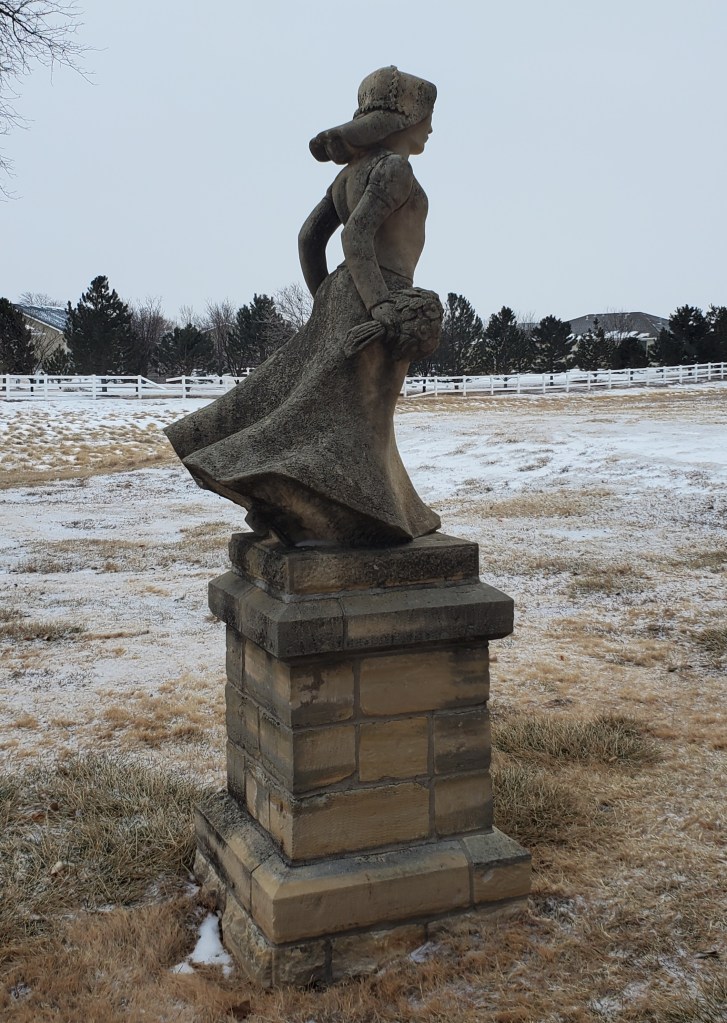
By IveGoneAway – Own work, CC BY-SA 4.0, https://commons.wikimedia.org/w/index.php?curid=128290695
As the burial party began to dig Elizabeth’s grave, they encountered a large slab of limestone just beneath the surface. Unable to penetrate the bedrock, Elizabeth Polly was laid to rest wearing the blue dress and white bonnet in which she had attended to her stricken patients. Elizabeth was accorded a full military funeral.
Mystery surrounds Elizabeth Polly’s final resting place. When Fort Hays was shuttered in 1889, the remains of the military personnel were disinterred and removed to Forts Riley and Leavenworth; the civilians were reburied north of Hays City, but no known grave of Elizabeth Polly was moved.
It is uncertain whether Elizabeth’s grave had a marker installed. A legend tells that four limestone posts marked the gravesite; these four pillars were subsequently removed by four men. Each of the men came to an unfortunate end after the supposed thefts; one man died in a gunfight; two perished in a carriage accident, and the last man was struck and killed by a train.
Elizabeth apparently rested in peace until 1917, when farmer John Schmidt observed a woman wearing a blue dress enter one of his farm buildings. When Schmidt followed her, the figure had disappeared.
Another reported sighting of Elizabeth occurred on a foggy night in the early 1950s, when a policeman patrolling the area around Sentinel Hill informed headquarters that he struck a woman wearing a blue dress and a white bonnet; when he got out of his vehicle to look for the pedestrian, he could find no body, and his car was undamaged.
Since John Schmidt’s encounter with the lady in the blue dress and white bonnet, there have been numerous other sightings continuing to the present day. Many witnesses report seeing an apparition emitting a hazy blue light, earning it the title of The Blue Light Lady.
One witness memorably recalled their own encounter with The Blue Light Lady: ‘The apparition crested the hill and floated above the prairie like a stray tumbleweed. It paused once to glance up at the full moon, then continued on its descent toward our hiding spot in the bushes. As the blue light drew closer, the shadows of her face became distinguishable features and the pattern of her long, prairie dress and bonnet came into view, and even though the apparition faded before touching the ground, I heard footsteps shuffling through the dirt.’
© Mark Young 2026
Sources
https://www.humanitieskansas.org/doccenter/a43c6d9b3982476aae2b61f62747c3df

 Hellish Fiends, and Brutish Men
Leave a comment