
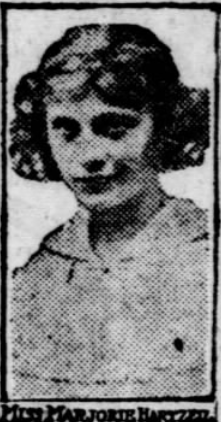
Marjorie Hartzell
On Wednesday, 9 April 1919, Marjorie Hartzell, a fifteen-year-old student, disappeared while walking to class at New Trier High School in the village of Winnetka, Illinois. At about 8.30 am, Marjorie was following two of her friends as they reached the Hubbard Woods station when the ’southbound electric car’ that would ferry them to school rumbled into the station.
‘Come on,’ one of Marjorie’s friends urged. Marjorie protested that she was too tired. The other two girls boarded; the last they saw of Marjorie was her walking towards the station. Marjorie never reached school that day, and she did not return to her 792 Scott Avenue, Hubbard Woods, home that evening, and her family could not understand what had happened. Marjorie’s mother told the press that her daughter had only 18 cents and an electric car ticket for Evanston when she disappeared.
Mrs Hartzell added that although Marjorie loved movies and dancing,’she cared nothing for the companionship of boys’. As an afterthought, Mrs Hartzell confided that she and Marjorie had had ‘a slight misunderstanding’ over the daughter’s ambition to become a ‘fancy dancer’, an aspiration which Mrs Hartzell discouraged. Friends of the Hartzell family feared that the girl had been abducted. One of these friends, H.J. Smith, suggested that one of the‘automobilists’ passing along that stretch of road may have lured Marjorie into a vehicle under the pretence of giving her a lift. Police immediately issued a description of Marjorie: ‘slender build, brown eyes, light brown hair, and olive complexion. She was wearing a black and white checked dress and tan oxfords,’ and distributed it to local stations.
After learning of his daughter’s disappearance, Samuel Hartzell, a contracting engineer for an Illinois fire extinguisher company, flew home from Kentucky, where he had been on a business trip.
A hyperbolic passage in the Chicago Times repeated local rumours that ‘Marjorie’s mangled body might have been recovered several times. At the very least she must have been kidnapped by a band of bolsheviki.’
When Samuel Hartzell aborted his business trip and returned home, concerned neighbours greeted him. Virginia, Marjorie’s younger sister, wondered if she had been ‘taken by a bad man?’ As the neighbours consoled Samuel, the house phone rang.
Mrs Hartzell (the newspapers didn’t provide a first name) answered the phone and, after hearing the caller, dropped the receiver. ’Sam,’ she called to her husband. ‘It’s mar-mar-mar-ma-it’s her.’
Sam Hartzell shrugged off the well-wishers and ran inside, picking up the fallen receiver; he heard Marjorie through sobs gasp: ‘I’m up in Milwaukee. I got a job as maid for Mrs Rogers…oh, papa, there’s the nicest little boy up here. And he knows how to Tickle-toe, too.’
Before she vanished, Marjorie told her teachers and classmates she was ‘crazy about dancing.’ As she left her home the morning she disappeared, Marjorie executed an elaborate twirl.
Sam Hartzell’s last words to his daughter before he replaced the receiver and dashed out the door to catch the next train to Milwaukee were: ‘Well, you come dancing home, your mother is nearly wild.’ The relieved father said Marjorie would not be punished for her abrupt vanishing act.
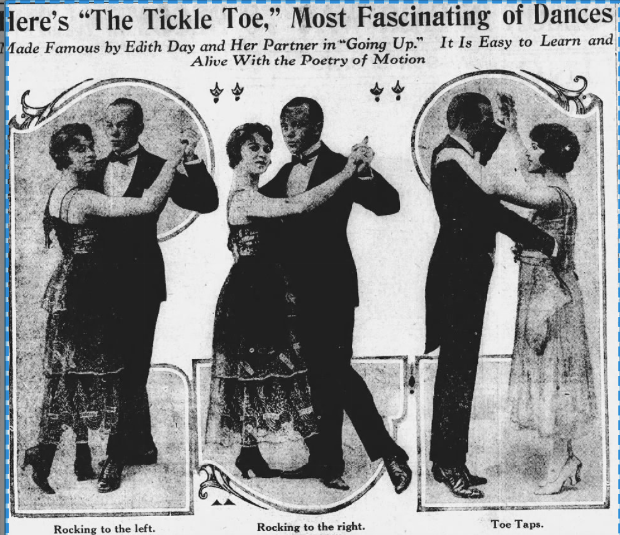
The Tickle-toe dance was created for the 1917 musical Going Up, written by Otto Harbach and James Montgomery, and based on Montgomery’s book The Aviator. Going Up premiered at New York’s Liberty Theatre. The dance Marjorie Hartzell so loved was called Everybody Ought to Know How to Do the Tickle-Toe.
In an article published in February 1918, The San Francisco Call Bulletin told readers that the song had all of New York ‘swaying with its cadences.’ The Call Bulletin reckoned that the dance was a ‘glorified Foxtrot.’ Adding that, ‘There are no complicated steps and no difficult acrobatic postures. It is a dance for everybody and can be done by the veriest amateur who is at all interested in dancing.’
© Mark Young 2026
Sources
https://www.newspapers.com/article/chicago-tribune-marjorie-hartzell/205909093
https://www.newspapers.com/article/the-pittsburgh-press-marjorie-phones-hom/205909844
https://en.wikipedia.org/wiki/Winnetka,_Illinois


Leave a comment