
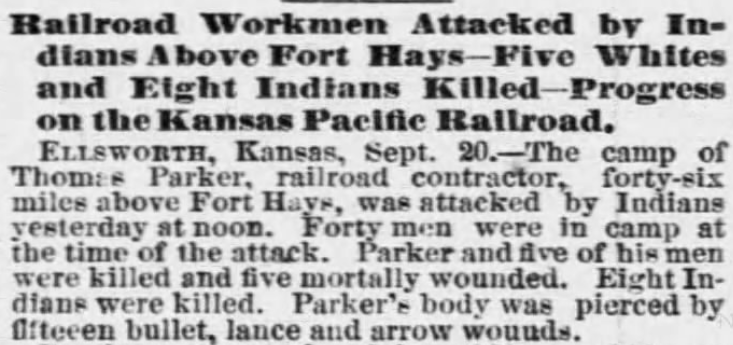
Chicago Tribune Saturday, 21 September 1867
Originally constructed in 1865 and named Fort Fletcher, Fort Hays occupied three sites on the Kansas Plains. The original Fort Fletcher was located south of the confluence of Big Creek and the North Fork of Big Creek in Western Kansas.
Fort Fletcher was intended to protect the Butterfield Overland Despatch Stage and act as a bulwark against the Plains Indians raiding along the length of the 592-mile Smoky Hill Trail. Named for the Smoky Hill River, whose course it paralleled for much of its length as it coursed between Atchison, Kansas, and Denver, Colorado, its western nexus.
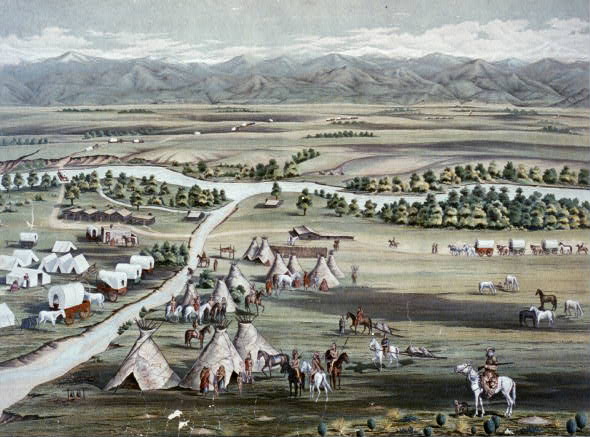
Denver in 1859
By V14256 U.S. Copyright Office. Associated name on shelflist card: Collier & Cleveland Litho Co. – Library of Congress Prints and Photographs Division Washington, D.C. 20540 USADIGITAL ID: (colour film copy slide) cph 3b49610 http://hdl.loc.gov/loc.pnp/cph.3b49610, Public Domain, https://commons.wikimedia.org/w/index.php?curid=1648024
The fort was named for the Missouri governor Thomas C. Fletcher. Lieutenant-Colonel William Tamblyn was given command of the post. Detachments of the 13th Missouri Cavalry, along with three companies of the 1st U.S. Volunteer Infantry, the so-called Galvanized Yankees, former Confederate prisoners-of-war who had sworn allegiance to the United States and joined the Union Army.
The Arapaho and Cheyenne defied the fort’s presence and continued to raid along the trail. The Butterfield Company went bankrupt, and the trail ceased to be used, and on 5 May 1866, Fort Fletcher closed.
In the following October, Fort Fletcher was re-established a short distance from the old site; its purpose was to protect the men working on the construction of the Union Pacific Railroad. The next month, the post was renamed in honour of Brigadier-General Alexander Hays, who had been slain at the Battle of the Wilderness during the American Civil War.
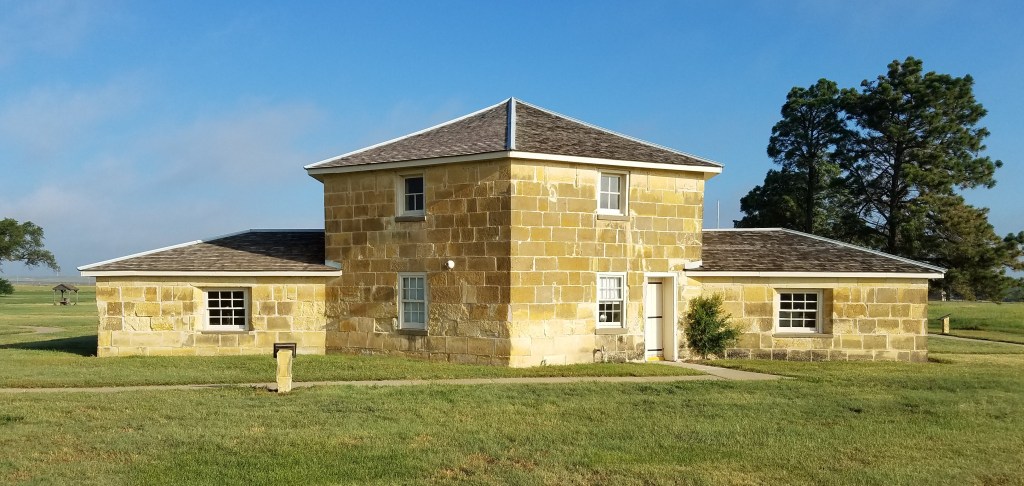
By IveGoneAway – Own work, CC BY-SA 4.0, https://commons.wikimedia.org/w/index.php?curid=56731646
On 7 June 1867, a powerful flood overwhelmed the fort, killing nine soldiers and civilians. Two weeks later, Major Alfred Gibbs, acting on orders from Major-General Winfield S. Hancock, chose a new location for the post, 15 miles to the northwest, close to where the railroad would cross Big Creek. The settlements of Rome and Hays City soon sprang up in the locale of the fort.
In this post, we are looking at a few of the encounters with Indians around Fort Hays in 1867. On the evening of 19 September, a group of labourers employed laying track for the Union Pacific Railroad were at dinner in their camp about forty miles west of Fort Hays. The men had lain 8,541 feet of track during the day and had undoubtedly earned their rest. Contractor Thomas Parks*, along with two companions, Charles Saffon ‘and a negro soldier of the 10th United States Cavalry (the famed Buffalo Soldiers)’, were hunting buffalo away from the camp, when a group of thirty Indians, identified in initial reports as Sioux, but were probably Cheyenne or their Arapaho allies, attacked the camp, but were driven off by the track layers.
Concerned for Parks and his comrades, a search party went out to look for them. Parks and the soldier (no newspaper bothered identifying him) were discovered beneath a projecting cliff of slate rock, which the Indians had collapsed on them. When their bodies were uncovered, Parks was found to have suffered fifteen wounds from bullets, arrows, and a lance. The Buffalo Soldier received five lance wounds to the back as well as a severe bullet wound in the thigh. The searchers found the scalped remains of Charles Saffon, he was the first of the men killed. Parks’ mount was taken away by the raiders; the soldier’s horse was killed in the pursuit. Eight of the Indian’s lost their lives in the attack on the Union Pacific men; Charles Saffon’s scalp was recovered among the possessions of the slain warriors. In the days after the attack, the newspapers reported that eleven of the track layers lost their lives. The next day, Parks’ body was conveyed by ‘McGrath’s ambulence’ to Fort Hays.
Earlier in the same week, a group of 30 labourers from ’Sharpe & Shaw’s camp’ were ‘driven in completely demoralised’ to Fort Hays, having been rescued by a party of 100 men from that post. The men had been pinned down in a dugout about five miles from the fort. Both Sharpe and Shaw had been reported as killed and scalped in the first reports; news was soon received that both were alive and well, but one of their comrades was slain in the action.
A few weeks after their narrow escape, Sharpe and Shaw, who had a contract for grading on the Union Pacific, sold out to R.M. Shoemaker ‘of the great railroad-building firm of Shoemaker & Co.’ And returned home.
Two days before the attack on Parks’ camp, during a raid on another group of workers, ‘one of Fisher’s men, after being killed, was horribly mutilated, and left naked on a grade with arrows through him in several places.’
The summer of 1867 saw numerous encounters between indigenous warriors and both the men constructing the Transcontinental Railroad and the soldiers manning Fort Hays and the other outposts. In an article published on Thursday, 31 October, in the issue of Pennsylvania’s Harrisburg Telegraph, the newspaper reported that in May, Indians had attacked the community of White Rock, three men and one boy were killed and scalped, and another boy was wounded but managed to escape when the murderers were scalping his father. The Telegraph added: ’Two women were taken prisoners, one of whom was outraged by a number of Indians, then killed and scalped. The other was taken away to suffer a worse fate, and has not since been heard of.’
In the same month, raids occurred in the Saline and Solomon Valleys, in which men, women and children were killed, and large amounts of property were carried off or destroyed. At the beginning of June, ‘the Indians murdered the family of Mr Thompson, consisting of his wife and four children.’ I was unable to find out any more information concerning this attack. However, at the end of the month, a Mr Thompson lost his stock to raiders he identified as Cheyennes and Kiowas, on the Smoky Hills; it remains uncertain as to whether this is the same man whose family were killed a few weeks before.
During July, two men were killed and scalped near Downer’s Station; one man near Fossil Creek and another at Walker’s Creek lost their lives. On either 28 July or 1 August, Clinton and Campbell’s camp, sited 10 miles east of Fort Hays on Big Creek, was struck. Seven members of the workforce were killed, and most of the stock was driven off.
Six of the slain men, including the camp foreman, P.S. Ashley, a native of Broadhead, Wisconsin, were buried where they fell; the last man, William Gould from Illinois, was interred in the post cemetery at Fort Hays. As well as the seemingly never-ending cycle of violence that swept the prairies that summer, the spectre of cholera was looming over the Kansas settlements.
* Also seen as Parker, Parkes and Parkas.
© Mark Young 2026
Sources
https://en.wikipedia.org/wiki/Kansas_Pacific_Railway
https://www.newspapers.com/article/chicago-tribune-railroad-workers-attacke/197807012


Leave a Reply