
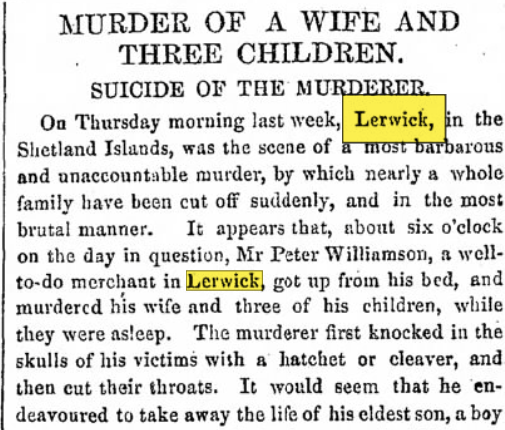
The Caledonian Mercury (Edinburgh), Friday 2 April 1858
With the hyperbole common to Victorian-era newspapers, the Tuesday, 6 April 1858 edition of the Edinburgh newspaper The Caledonian Mercury published an item that had first been reported in the John o’Groats Journal
‘inhabitants…were startled by the announcement that during the previous night the house of one of the most respectable of their townsmen had been the scene of a tragedy more horrible in its details than any that had ever, within the memory of man, occurred in the northern counties, if not parallel in atrocity to any domestic tragedy recorded in the criminal annals of the country for a long time past.’
In 1858, Lerwick, consisting ‘of one straggling street, which is intersected by a number of narrow lanes’, was, as it remains today, the largest town in the Shetland Islands, the most northerly archipelago in the British Isles.
There was a numb disbelief that enveloped the residents of Lerwick on the morning of Thursday, 25 March 1858. A town which was little used to crime was shocked by the news of the murder of four members of the Williamson household, apparently by the patriarch of the family, the ‘estimable, kind-hearted,’ Peter Williamson.
Peter Williamson’s heavily pregnant wife, whose name went unrecorded by the newspapers, was believed to be the first victim, ‘an exemplary and superior person’. She had, the newspaper reported, been struck on the head by a cleaver as she slept. She was found lying on the floor of the main bedroom ‘weltering in blood.’ Mrs Williamson, although grievously injured, clung onto life until the alarm was raised the following morning.
12-year-old Agnes, the Williamsons’ only daughter, had been suffering from an illness and was sharing her parents’ bedroom. Peter Williamson beat his daughter around the head before finally slitting Agnes’ throat with a razor.
Three of the Williamson brothers shared a bedroom in the attic on the third floor. Gilbert, the fourth brother, was luckily for him absent from home, visiting relatives in his father’s home village of Northmavine, in the north of Manland, the largest of the Shetland Isles.
After attacking his wife and daughter, Williamson climbed the stairs to where the boys had been roused from their sleep by the sound of their father assaulting their mother and sister on the lower floor. As Peter Williamson gained the room, the brothers managed for a short time to keep the murderous patriarch at arm’s length.
William, the oldest of the three boys ensconced in the bedroom, received several blows to the head and a terrible gash to the throat before his father could accomplish his design; the 16-year-old fled down the stairs. John, the second son, tried to evade his father in his ’night-dress’. His father chased him and grabbed hold of him as John leapt onto an unoccupied bed.
Williamson soon grabbed hold of John, and, as with his other victims, beat the child about the head with a cleaver, before slitting John’s throat. The last victim was the youngest, Peter, named for his father, and yet to have celebrated his fifth birthday, was disposed of in the same manner as the other victims.
Peter Williamson killed himself in his sons’ bedroom by slitting his throat.
After escaping his father’s clutches, William Williamson raced to his mother’s room. When he saw the blood-soaked carnage in his parents’ bedroom, William ran down the stairs and entered the kitchen where he encountered the household’s maid servant; the servant was ‘beside herself with fright’ when confronted with the sight of the gravely injured William.
It was the maid servant’s screams on seeing William’s terrible injuries which alerted a number of workmen in a nearby street. A local policeman was sent for, and in the meantime ’some of the more respectable neighbours…with a medical gentleman, made bold to enter the house.’
As mentioned above, Mrs Williamson still clung to life as the cohort of neighbours entered the house. She could not speak, and viewed the newcomers through half-closed eyes. William Williamson’s windpipe was slashed, and it was believed that he would not survive, but ‘by the aid of the surgeon, his dangerous wounds are slowly healing. He is not yet, however, altogether out of danger, and it is doubtful if he will ever sufficiently recover his natural strength.’
The following Tuesday, 30 March, Peter Williamson and his four victims were buried together, ‘and a more mournful cortege was never seen in the streets of Lerwick.’
After the murders, thoughts turned to what could have caused Williamson to kill four members of his family and inflict serious injuries on a fifth. He had formerly had a reputation as a heavy-drinker, but in recent years had become abstemious. The media posited that Williamson had been affected by the recent death of a close friend, but in reality no one knows why the family patriarch, a loving husband and father, a successful businessman, killed four members of his family and attempted to murder a fifth late on a spring night in 1858.
© Mark Young 2026
Sources


Leave a Reply