
The image of a highwayman in the public imagination, as seen in innumerable novels and films, is a courteous, gallant gentleman of the road, perhaps a victim of injustice, a heroic equestrian seeking to outwit his usually corrupt opponents as the shadow of the gallows hangs over him.
Jocelin Harwood, born in the village of Wateringbury, Kent, in 1669, bore little resemblance to the popular image of a Knight of the Road. The Newgate Calendar stated that when he was seventeen, Jocelin ran away from home, taking with him £60, which he had stolen from his father. The sum he absconded with was undoubtedly exaggerated; £60 in 1686 would be worth over £10,000 in 2026, and the same source says the thief soon frittered it away when he reached London.
Jocelin Harwood turned to pickpocketing and the occasional theft from homes and businesses. After three years of small-scale thieving, Harwood left pocket-picking behind and decided the King’s Highway held greater riches for the upwardly-mobile criminal.
Harwood stole a horse and its accoutrements, a brace of pistols, and headed for Blackheath. Today Blackheath is in south-east London; in Jocelin Harwood’s time, it was a desolate, windswept stretch of land outside the city. Dick Turpin, England’s most well-known highwayman, is reputed to have stalked Blackheath in the 1730s.
Mounted on his stolen steed and armed with a pair of horse pistols, Harwood rode out onto Blackheath, where he encountered two travellers. Harwood produced his pistols; instead of meekly acquiescing to the highwayman’s demand that they should ’stand and deliver’, the men produced their own weapons. The adversaries exchanged shots; Harwood’s mount was killed by a pistol ball, and set afoot, Harwood would surely have been captured if he had not managed to inflict wounds on his antagonists.
Harwood fled the scene, relieved that his only loss had been his horse. Jocelin kept a low profile for a while. At length, Harwood returned to the life of crime; for the next few years, Harwood assailed travellers on the approaches to London.
In 1692, Jocelin Harwood and a group of like-minded associates appeared at Sir Nehemiah Burroughs’ house in Shropshire. Harwood and his confederates were told that the Burroughs’ residence contained great riches. Harwood and two of his gang members entered the house, quickly overpowered the servants, and restrained them.
Jocelin Harwood and his men soon subdued and secured Sir Nehemiah and his wife. Harwood entered the bedroom of Sir Nehemiah’s two daughters. One of the girls said to Harwood: ‘Pray, sir, use us civilly; which if you do, we will use you in the same manner, in case you and your companions should be taken; for I am sure we shall know you again.’
Harwood sneered: ‘Shall you so?’ He unsheathed his sword, and added: ‘I’ll take care then to prevent your doing any mischief.’ Harwood then eviscerated both sisters before returning to where their parents cowered. ‘And do you know me too?’ He asked the terrified parents of the two slain girls. Apparently, Sir Nehemiah and his wife said they couldn’t identify Harwood. ‘The inhuman wretch’, answered: ‘You are only a little more artful than your daughters, but I shan’t trust you.’ Harwood then dispatched husband and wife in the same manner as he had dealt with the daughters.
According to the Newgate Calendar, which is the only source we have for the murderous assault on the Burroughs’ house, Harwood’s associates were so shocked by his actions that they were unable to respond. But later, as the party fled with the plunder they had stolen, one member of the gang shot Harwood’s horse from under him.
The former allies quickly bound Harwood hand and foot, and left him on the road leading from the scene of the night’s murderous escapade. One of the men told Harwood that their actions were ‘a just requital for his inhumanity.’
The following day, when news of the depredations reached the wider public, searches were launched, and Jocelin Harwood was discovered still hogtied where his former confreres had left him. Harwood was transported to Shrewsbury jail, where he behaved badly. During the trial that followed his apprehension, Harwood is alleged to have spat in the faces of the judge and members of the Jury.
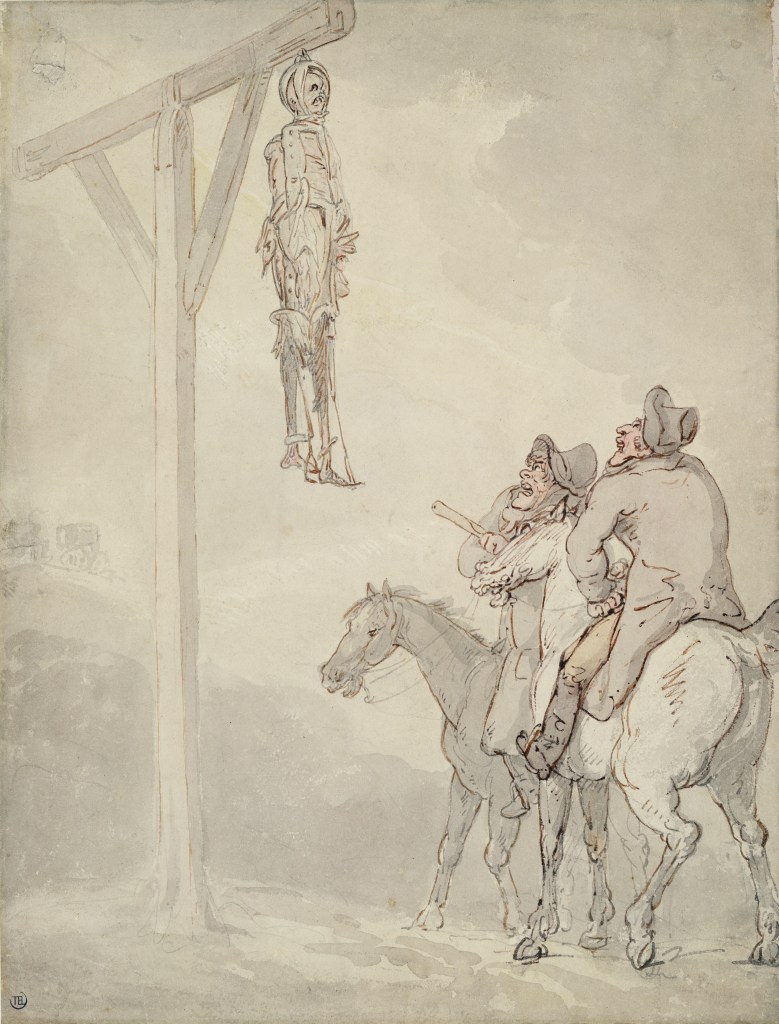
Harwood, ‘a degenerate plant from a good tree ’, was unsurprisingly quickly found guilty and sentenced to death, after which his body was to be hanged in a gibbet ‘for a public spectacle.’ He continued to curse his jailers and court officials with ‘the same horrid course of oaths, profaneness and blasphemies till his death.’
As he stood on the scaffold, Harwood stated: ‘that he would act the same murder again, in the same case. This is all he would say to anybody.’ Jocelin Harwood was 23 when he danced the hempen jig at Shrewsbury Jail.
During my research, I could find no information on Sir Nehemiah Burroughs and the murders that allegedly took place at his house in 1692. The only information I could find about Jocelin Harwood came from the Newgate Calendar cited in this post’s source, which several other websites repeat verbatim.
© Mark Young 2026
Source


Leave a Reply