
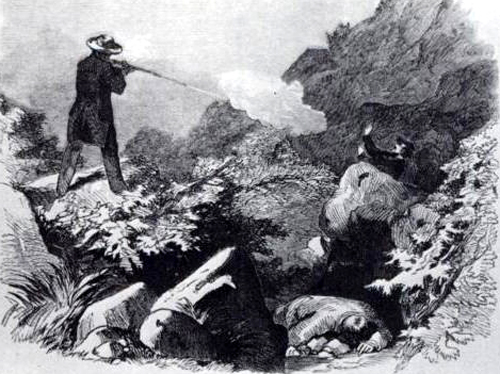
By Unknown author – http://www.legendsofamerica.com/photos-oldwest/Venard%20Gunfight.jpg, Public Domain, https://commons.wikimedia.org/w/index.php?curid=12367272
Towards the end of April 1866, Samuel Henry of Moore’s Flat, California, was driving his wagon up Yuba Hill when he was stopped by two pistol-wielding robbers who ordered him down from his ‘sulky’. The two men carried out a systematic search of Henry’s wagon, finding only a concealed Colt revolver.
The bandits asked: ‘How it happened that I (Henry) had no coin?’ Henry answered that he didn’t carry any money with him, ‘as there were too many road agents around.’ The robbers relieved Henry of a diamond ring, his watch and the Colt, which belonged to R.C. Black, an acquaintance of his residing in Humbug.
Samuel Henry would later identify the robbers, one who addressed him by his name, as Bob Finn and Jack Williams. The man Henry asserted to be Jack Williams was, in fact, George Shanks, Jack Williams having been hanged about ten years before.
By the time of the Yuba Hill robbery, George Shanks had lived a full and interesting life before he set foot in California, sometime around 1855. Historian Dan L. Thrapp suggests that Shanks was born in New York City, where he possibly worked in the newspaper industry.
During the American Civil War (1861-65), he twice joined and deserted the Union Army. At Nevada City, in 1864, working as a cook and using the alias Billy Smith, he tried, for unknown reasons, to assassinate William Barton, the man for whom he worked.
After an alleged shooting at Colfax, Shanks relocated to Grass Valley, a few miles south of Nevada City. While at Grass Valley, Shanks adopted the name Jack Williams, as noted above, the real Jack Williams had been hanged sometime before.
It was at this time that Shanks turned his hand to stagecoach robbery, often in concert with George Moore and Robert (Bob) Finn, both of whom were notorious ‘hard cases’ and had spent time in prison.
On Tuesday, 15 May 1866, west of Grass Valley, Shanks and his two associates held up a Wells, Fargo stagecoach. ‘Put on your brake, and throw off the express box!’ Demanded George Shanks.
Shanks then told Sam Cooper to climb down from the coach and unharness the horses. He then ordered the seven passengers. Each of the passengers (all men) was then searched for weapons and forced to stand in a line with their hands up. Shanks told George Moore: ‘We don’t want to harm any of these gentlemen…if any of them makes a motion…blow his brains out!’
Shanks then relieved the passengers of three gold watches and money, which, according to later newspaper reports, amounted to less than $1,000. Still, combined with the $7,900-$8,000 in gold dustthe strongbox held, it wasn’t a bad haul for the three road agents.
Shanks blew open the strongbox with gunpowder. Bob Finn instructed the passengers to help Sam Cooper re-harness the team to the coach. Once that task was completed, Moore covered the passengers with his pistol as they filed back aboard their conveyance. As soon as Shanks and Finn had ridden away, Moore released the stagecoach, ‘and soon the coach was rolling over the road…at a rate which would have made the celebrated son of Nimshi, even, ashamed of himself’. In the Old West, stagecoach drivers were often referred to as the Jehu; in the Bible, Jehu is the son of Nimshi.
Piloted by Sam Cooper, the stagecoach trundled into Nevada City at six a.m. Cooper brought the coach to a halt outside Lancaster and Hosey’s National Exchange Hotel. Despite the early hour, ‘the news of the daring robbery spread like wildfire throughout the town, and the greatest excitement imaginable prevailed.’
Within an hour of the arrival of the San Juan Stage, R.B. Gentry, sheriff of San Juan County, had assembled a posse consisting of James H. Lee, A. W. Potter, and Ohio-born Steve Venard, along with the sheriff’s brother, Alf Gentry.
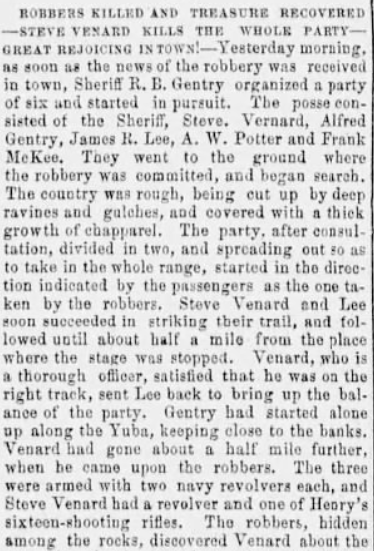
Two hours after the stage had arrived at Nevada City, the posse reached the scene of the hold-up. The posse split up; the Gentrys and Potter entered some woods near a stream; Venard and Lee followed the North San Juan Road, which ran parallel to the stream.
Shortly after the posse had separated, Venard and Lee found and followed the robbers’ trail. Believing that they would end up at Holt’s Crossing, James Lee went back and took the pair’s horses to that road.
Meanwhile, Steve Venard carried on the trail until he reached the South Yuba River near the mouth of Myers’ Ravine. Venard discovered that the bandits had not yet crossed the river or the ravine, which was described by the Nevada Transcript as ‘a mass of huge rocks rising in the midst of this torrent.’
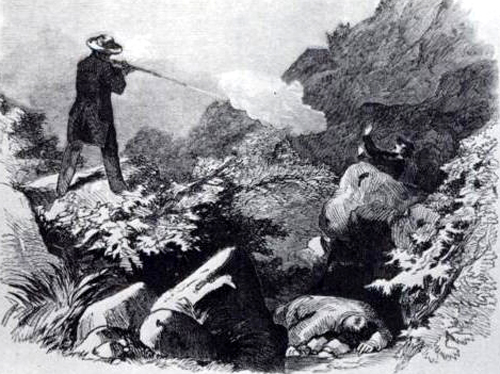
Venard crossed Myers’ Ravine at its lowest point. As he made his way across, the posseman heard an unusual noise that made him pause. Pushing on, Venard passed through a natural alley in the rocks. When he reached the base of a large rock that loomed over him, Venard saw one of the robbers perched on a rock about twenty-five feet from him. The man saw Venard at the same time and pulled his revolver from his holster.
Venard brought his Henry rifle to bear on the outlaw when movement caught his eye; it was one of the other robbers, who was bringing his own weapon to bear on Venard. Not having time to change his aim, Venard fired his Henry at the first man; the robber fell from the rocks, and the second robber then ducked into a cleft in the rocks.
When the second robber moved his head into view, Venard fired, and the man fell from view. Venard tried to control his breathing as he scanned the ravine for signs of the third man. He rushed up the incline to where the robbers had been hiding. He discovered the bodies of the two men he had shot, and he took their pistols from them. Bags of gold dust stolen from the San Juan stage lay at their feet. He moved the bags a short distance and covered them, hiding them from view.
Venard then continued his pursuit of the third robber. Cresting a peak of the ravine, Venard saw a man sprinting up the mountain, desperate to make his escape. Once more, the posseman levelled his rifle and fired. The man was about sixty yards from Venard, and he pitched forward as the slug from the Henry struck him. Although the robber was wounded, surrender, if it was requested by Venard, did not occur to him. He tried to continue his flight on his hands and knees. The Henry barked once more; the robber, hit for a second time, stopped and turned to look at his pursuer, then his head fell, and he rolled down the hill.
When Venard met up with the rest of the posse, he was, according to the San Luis Obispo Tribune, ‘Overflowing with Glee and excitement.’ He burst out, ‘I’ve got ‘em, Gentry!’ Adding ‘All of ’em ⎯ every mother’s son of ‘em!’
Sheriff Gentry responded: ‘Where are they?’
‘Scattered about promiscuously.’
‘Not dead?’
Venard confirmed that the hold-up men were all ‘dead as a door-nail, cold as a hammer. And the only thing I regret is that I threw away a valuable shot on one of the scoundrels. I am fairly and squarely a cartridge out.’
The posse, joined by a group of latecomers who had been encouraged to join the pursuit of the robbers by Wells, Fargo, which posted a $3,000 reward, conveyed the dead men back to Nevada City, arriving in mid-afternoon.
An inquest was begun the evening the posse returned to Nevada City and continued into the next day. The jury took only a few minutes to consider their verdict, announcing that the three outlaws were lawfully killed by Steve Venard in the discharge of his duty. From Wells, Fargo, Venard received a new Henry rifle and the $3,000 reward, which he split with the other posse members.
© Mark Young 2026
Sources
Encyclopedia of Frontier Biography, vol III. By Dan L. Thrapp

 Hellish Fiends, and Brutish Men
Leave a comment