
The Vancouver Island-built steamer Emily Harris made a brief appearance in a previous post. In 1864, the craft had carried three labourers who had been engaged in the construction of a road through the Cariboo goldfields in the Colony of British Columbia, from Nanaimo to Victoria, after they had survived an attack on their camp by a party of Tsilhqot’in men.*
Constructed in 1861, the Emily Harris was the fourth steamer built in the colony of Vancouver Island. The vessel was built by Peter Holmes, following a design by James W. Trahey. The steamer was named for the daughter of Thomas Harris, the first mayor of Victoria. Harris, Carroll & Co. owned the ship from its launch till it was sold in 1863.
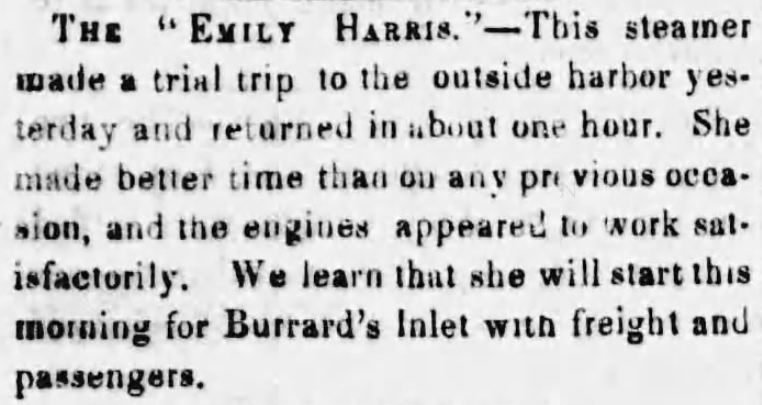
When it was launched in 1861, the Emily Harris was served by two captains, John S. Titcombe, who was born in Upper Canada (now Ontario) to Irish parents. In 1859, he qualified as British Columbia’s first officially licensed pilot. In 1862, Titcombe was appointed as Revenue Collector to collect duties from all vessels transporting cargo from Victoria to the coast of British Columbia. Titcombe died in 1869. Information regarding Emily Harris’ second captain, Alexander Court, is sadly lacking in the historic record.
In January 1862, a rumour spread throughout Victoria that the Emily Harris had been lost en route from Victoria to Burrard Inlet on the mainland. It was only when the captain of the sloop Alarm reached the colony’s capital that the truth was conveyed. The vessel had travelled to the mouth of the Fraser River, but the quantity of ice forced the Emily Harris to return to Nanaimo for coal. After refuelling, the steamer headed towards the mainland. The Alarm’s captain reported that all on board, ‘were in good health, and as jolly as the circumstances would permit.’ The winter of 1861-62 was unusually severe in the colonies of British Columbia and Vancouver Island.
In February of the same year, the steamer made at least three round trips to the mainline. On 4 February, the Emily Harris returned to Victoria with $40,000 in gold dust, and the news that the severe weather had wreaked havoc amongst the settlers’ livestock, ‘Mr. McRoberts, a settler near New Westminster, has lost 85 head of cattle out of 105’.
One week later, the steamer returned to Victoria with another $30,000 in gold dust aboard. Two weeks later, 21 passengers disembarked the vessel in Victoria’s harbour, toting $80,000 in gold dust amongst their possessions.
In 1861, Alexander Choquette discovered gold on the Stikine River in northern British Columbia. Once news spread to the outside world, a stampede of prospectors eager for their share of the riches ensued. Steamers abandoned the Fraser River to transport argonauts to the northern waterway.
George Barnett, a prospector who journeyed to the Stikine aboard the steamer Flying Dutchman, remarked that a few companies of men were making upwards of $50 a day. Barnett, in a letter published in Victoria’s Daily Evening Press, did not believe the Stikine would yield as much gold as the Fraser, an opinion that would prove correct.
On Sunday, 24 August, the Emily Harris returned to Victoria, accompanied by the Flying Dutchman. The Harris carried on board 10 passengers and a cargo of sheep, which it had transported to the Stikine in the hope of selling to the miners. The Daily Evening Press reckoned that few of the sheep were sold.
The Victoria newspapers portrayed the Stikine River as a lawless region, even more so than the Cariboo, which was featured in a previous post**. On Tuesday, 26 August, the Weekly British Colonist reported that: ‘Two drunken Indians’, accused of stealing a canoe, were killed by prospectors. The same issue informed the readership of attacks by indigenous men on canoes carrying miners on the Stikine, alleging that two miners were killed.
It wasn’t only the First Nations’ men harassing the prospectors; The Daily Evening Press announced that two miners headed down the Stikine were robbed of $600 in gold dust and coins. ’The person accused is a man who has served a term in the Victoria chain-gang for selling whisky to Indians…as he is known amongst the miners…there is every reason to believe that Judge Lynch…will find a victim’.
As in the Cariboo, smallpox carried by the settlers was prevalent on the Stkine; ‘whole villages have been swept away by the dread disease.’
Earlier in the year, the Harris had been withdrawn from the Stikine route due to a lack of passengers. The initial excitement of the Stikine rush had faded, and the Evening Press revealed that men were choosing to head to the Cariboo rather than the northern reaches of the colony.
After being removed from the Stikine route, the steamer travelled to the Olympia Peninsula in Washington Territory, returning with: ‘2 horses…140 sheep…3 bxs eggs…value, $1330’.
After returning from the Stikine, the Emily Harris spent most of her time plying the waters between Nanaimo and Victoria. It was in May 1864 when she returned to the colony’s capital with three survivors of the attack on the labourers building Alfred Waddington’s road from Bute Inlet*.
By this time, the steamer was commanded by Captain Mcintosh, who served aboard the vessel until 1871. Master Mariner Alexander Chambers joined the crew in 1864 or 1865. Chambers was one of the first two men to be awarded a Marine Pilot’s licence for Burrard Inlet-Fraser River- Gulf of Georgia to the Strait of Juan de Fuca in the Salish Sea.
The last man to command the Emily Harris was Captain James Frain. Frain had been a navigator on the Oregon Territory’s Umpqua River, and at Coos Bay, Washington Territory, before moving north of the line into British Columbia.
Frain operated several steamers on the Fraser River, including the Fly and Cariboo. He was also the master of the Caledonian. He took command of the Emily Harris in 1865. The vessel continued to work the route from Victoria to Nanaimo; the journey was about 65 nautical miles.
By 1871, with James Frain still at the helm, the steamer was once more venturing north to serve the Skeena River community. Captain McIntosh, who had first stepped on deck some years earlier, was still often to be found on the steamer as she plied the Victoria-Nanaimo route.
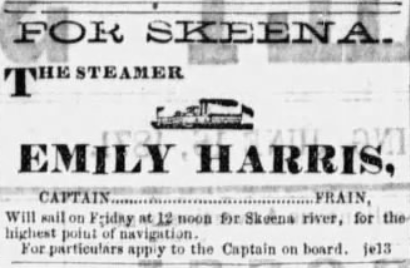
In August 1871, with McIntosh having been confined to his sickbed for several weeks, James Frain embarked on the last voyage of the Emily Harris as she left Nanaimo harbour, returning to her home port of Victoria.
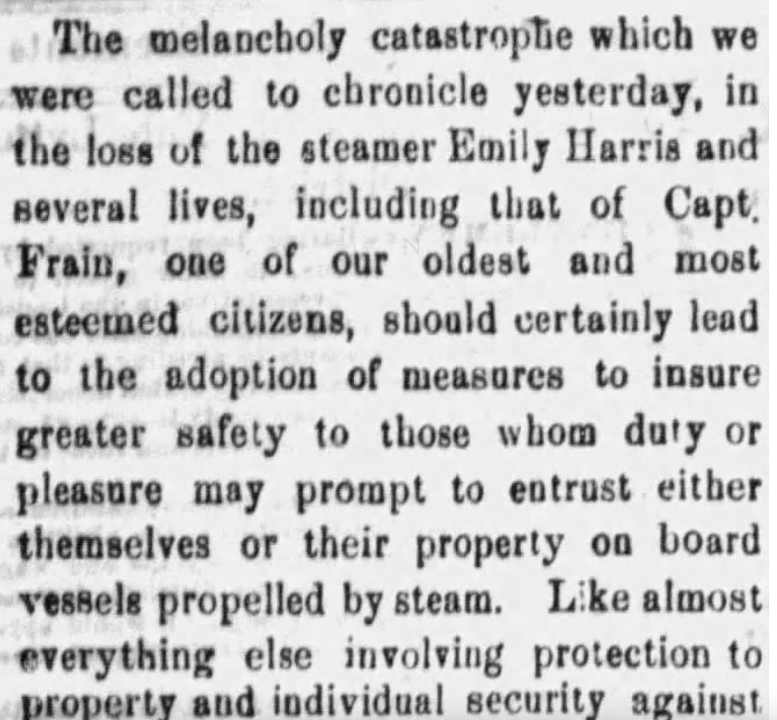
On Friday, 18 August 1871, The Victoria Daily Standard broke the news to its readers that the steamer Douglas (there is some confusion as to what vessel this was, it was either the Governor Douglas, buit in 1858, or the patrol vessel Sir James Douglas, constructed in 1865), conveyed the information that the Emily Harris had been lost en route from Nanaimo to Victoria, laden with 70 tons of coal, and carrying a solitary passenger, John Lyman, a quarry worker from Newcastle Island, a small spot of land a short distance from Nanaimo. Serving with Captain Frain aboard the steamer were a Chinese cook (whose name was not recorded) and ‘four Indian hands’.
The Standard reported that sometime after 8 pm, on Monday, 14 August, as the Emily Harris was in the vicinity of Salt Spring Island, an explosion in the boiler rocked the vessel, sending the steamer ’stern foremost’ beneath the waves.
The day after the Harris went down, the Douglas, heading to Nanaimo from the capital, was passing Salt Spring Island, when it was ‘hailed by a canoe, which came alongside, and contained two white men, one of whom was Mr. Sampson, the constable of Salt Spring, and the four Indians, the hands of the ill-fated steamer’.
Henry Sampson, the Kent-born constable of Salt Spring Island, had arrived on Vancouver Island in 1849. Five years before the loss of Captain Frain’s steamer, he had arrested his own wife as an accomplice in the attempted poisoning of a neighbour.
The Douglas cancelled its scheduled trip to Nanaimo and instead transported the four Indigenous men to Victoria. Once back on dry land, the surviving crew members were interviewed by the authorities.
In a statement published by the Victoria Daily Standard, ‘Joe’, the ‘Indian’ who was in charge of the engine when the explosion tore through the 100-foot steamer, went up on deck, and told Captain Frain that ‘there was something wrong down below, and to look out and get ready to jump overboard.’
Joe explained that before Frain could answer, the boiler exploded, and Joe, the rest of the crew, along with passenger John Lyman, found themselves in the water. Joe said the Chinese cook immediately sank beneath the waves and was not seen again.
Captain Frain and Joe both managed to grab hold of wooden planks; Lyman grabbed hold of a barrel as it floated past, but every time he tried to get astride it, the tide carried the barrel away. Lyman fell under the waves, and like the cook, he failed to resurface.
An unnamed First Nations man asleep in the forecastle was unaware of anything wrong until he woke to find himself in the water. The man at the wheel of the steamer was blown overboard with the wheelhouse. He survived the incident with a dislocated knee.
A short time later, Frain called out, ‘Joe, are you there?’
Joe reported that the captain kept saying, ‘Joe, Joe’. Eventually, Frain was silent, and Joe didn’t know if he had drifted away or had slipped beneath the water. Clinging to pieces of the wreckage of the Emily Harris, guided by Tsimshian campfires, the four Indigenous men made landfall about three miles from where the steamer went down.
It isn’t clear whether Joe and his three comrades from the steamer were also Tsimshian, but after the men had battled for four hours to reach the shore, the Tsimshian fed them and gave them dry clothes.
After news of Joe’s report was made public, doubt was cast on its veracity. The Victoria Daily Standard found it strange that Joe had apparently had time to gather his best clothes before the explosion. Joe was also the only uninjured member of the crew. As noted above, the helmsman had dislocated his knee, while the other two crewmen had suffered scalds from the exploding boiler.
On Saturday, 19 August, the Douglas returned to Victoria after searching for the three men missing from the Emily Harris. They met with Constable Sampson, who informed them that he had heard nothing of the explosion until Joe and his comrades arrived on Salt Spring Island. The Douglas discovered two doors from the Harris’ cabin, as well as a barrel and a pair of planks. No sign of Captain Frain or the Chinese cook, and John Lyman was found.
Henry Sampson and some other residents of the island had searched for the missing men the morning after the incident, but like Captain Clarke, the skipper of the Douglas, they had come up empty-handed.
On Saturday, 23 December, The Victoria Daily Standard reported an interesting development in the sinking of the Emily Harris: ‘A Salt Spring Island farmer in town yesterday informed us that an Indian residing at Ganges Bay, S.S.I (Salt Spring Island) had in his possession for 3 months past, the Emily Harris boat, and from all appearance, it never went down with the steamer.’
The newspaper added that at the time of the vessel’s loss, foul play had been suspected. The popular belief was that Joe and his comrades had used the boat to get away after the explosion. The Standard noted that the man in whose possession the boat was found was the brother-in-law of Constable Henry Sampson. The paper lamented the fact that there had been no enquiry into the loss of the steamer.
One month later, The Standard reported that ‘Johnny, an Indian, on remand, was charged with stealing a boat belonging to the lost steamer Emily Harris. The prisoner, after several remands, was discharged.’ The paper also published a correction; ‘Johnny’ was not Henry Sampson’s brother-in-law.
© Mark Young 2026
* https://historicalmusings.co.uk/2024/11/23/death-on-alfred-waddingtons-road-the-1864-tsilhqotin-war/
** https://historicalmusings.co.uk/2025/06/08/a-form-of-society-so-crude-death-in-the-cariboo/
Sources
https://canadianmysteries.ca/sites/robinson/murder/castofcharacters/1716en.html
https://nauticapedia.ca/Gallery/Pacific_Pilots.phpws


Leave a Reply