
In a previous post, we covered the story of the Dunsdon brothers. Today, we are looking at some other Highwaymen who haunted Oxfordshire’s roads during the Early Modern Period.
Claude Duval and James Hind are the two most famous highwaymen associated with Oxfordshire. Duval was born in Normandy in 1643. He moved to Paris and eventually worked as a stable boy for a group of English Royalists. After the restoration of the monarchy in 1660, he crossed the Channel and worked as a footman for the Duke of Richmond.
Soon, Duval turned to highway Robbery, reportedly eschewing violence; unlike most of his contemporaries, he plied the roads around the capital, particularly Holloway, between Highgate and Islington.
The authorities posted a large reward for Duval’s apprehension, and he fled to France, returning to England a few months later. Duval was captured at the Hole-in-the-Wall tavern, Chandos Street in Covent Garden.
In January 1670, Duval was tried and convicted of six robberies; he was hanged at Tyburn on 21 January. His body was cut down and displayed at the Tangier Tavern, drawing a large crowd.
Duval was reportedly buried under the centre aisle at St. Paul’s Church, Covent Garden. A memorial reads in part, ‘Here lies DuVall: Reder, if male thou art, look to thy purse; if female to thy heart…Old Tyburn’s glory; England’s illustrious thief, Du Vall, the ladies’ joy; Du Vall, the ladies’ grief.’
The Holt Hotel, formerly Hopcrofts Holt Inn, sited on the A4260, just outside Steeple Aston, Oxfordshire, was established in 1475. According to the hotel’s website, Duval frequented what was then a coaching inn during his career. The ghost of the French highwayman is said to haunt the hotel as a shadowy figure on the stairs, or perhaps you might hear the pounding of his horses’ hooves.
The Claude Duval Bridleroute crosses parts of Buckinghamshire and Oxfordshire. It is a 90-mile (145-km) trail for cyclists, walkers, and horse riders.
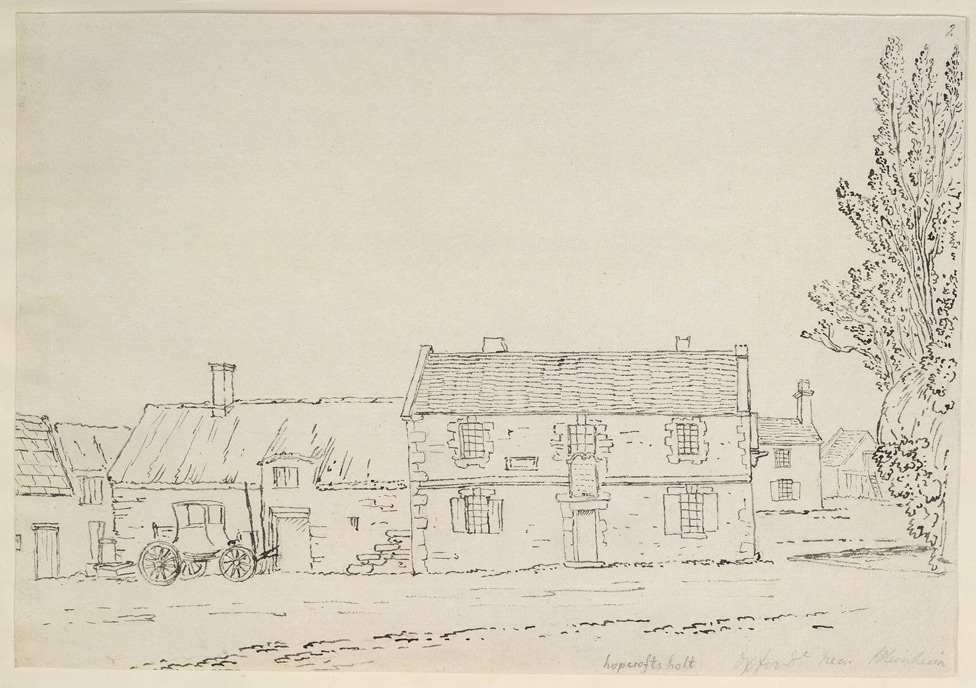
Hopcrofts Holt circa 1783
By Samuel Hieronymus Grimm – British Library [1], 2011-05-30, Public Domain, https://commons.wikimedia.org/w/index.php?curid=15357755
James Hind was born around 1616 in Chipping Norton. His father was a saddler, and the young James served a brief apprenticeship to a butcher in the town. Hind is believed to have been present at the Battle of Worcester in 1651, the last significant engagement of the English Civil Wars, and may also have helped Charles II escape.
According to the Newgate Calendar, Hind’s first act of highway robbery was on Shooters Hill. He was accompanied by Thomas Allen, an experienced criminal who had encountered Hind while the two were incarcerated in Newgate Prison.
Hind robbed a gentleman and his servant of £15 while Thomas Allen observed the hold-up from a distance, wishing to observe whether Hind was a fit partner for him. Hind returned 20 shillings to the gentleman, ’to bear his expenses on the road.’ Impressed by the younger man’s bravery and generosity, the two immediately agreed to form a partnership.
Not long after, Charles I was tried for treason and executed at Whitehall. Hind and Allen were both committed to the Royalist cause. On their way from Huntingdon to London, they stopped the coach of the Lord Protector. Oliver Cromwell had an escort of troopers who quickly captured Allen and forced Hind to flee.
Cromwell was not the only Parliamentarian Hind attempted to rob. John Bradshaw, the man who had passed sentence of death upon Charles I, was encountered on the road between Sherbourne and Shaftesbury in Dorset. Bradshaw introduced himself to Hind, ’supposing his name would carry terror with it.’
Hind responded, ‘I fear neither you or any king-killing son of a whore alive. I have now as much power over you as you lately had over the king, and I should do God and my country good service if I made the same use of it; but live villain, to suffer the pangs of thine own conscience…unless thou deliverest thy money immediately, thou shalt die for thy obstinacy.’
Bradshaw handed the highwayman a purse containing forty shillings. Hind brandished a pistol at the regicide and promised to shoot him through the heart if he did not hand over ‘coin of another species.’ Bradshaw quickly furnished Hind with ‘a purse full of jacobuses.’
After the Battle of Worcester, Hind returned to London, where he took lodgings in Fleet Street, assuming the alias of Brown. Despite the pseudonym, Hind was betrayed by an ‘intimate acquaintance’ and apprehended. Upon his capture, he was taken to the Speaker of the House of Commons. After a lengthy interrogation, he was detained at Newgate Prison.
In December 1651, he was indicted at the Old Bailey for several crimes. He was then moved to Reading, where he was tried for the murder of George Sympson. Hind was duly convicted of wilful murder. An Act of Oblivion was issued the following day, forgiving all offences except those committed against the state, giving hope that he would escape with his life.
Instead of being released, an Order of Council was issued, removing him to Worcester Jail. At the beginning of September 1652, James Hind was found guilty of high treason, and on September 24, he was drawn, hanged and quartered.
Before he was executed, Hind stated that most of his robberies were committed against ‘the republican party, of whose principles he professed he always had an utter abhorrence.’ He added that the only thing that troubled him about his execution was that he would never see ‘his Royal master established on his throne.’
After the sentence was carried out, Hind’s head was placed on the Bridge Gate, overlooking the River Severn; it was removed a week later and buried. His quarters were displayed on the other gates of the city, where they remained until the weather destroyed them.
Shotover Hill was a popular haunt for highwaymen in the early modern period. John Cottington, popularly known as Mul-Sack, sack being his favourite drink, learned that an army pay wagon was travelling from London to Oxford and Gloucester to pay the soldiers stationed at those two cities.
As the wagon slowly rolled up the steep hill, Cottington approached the wagon driver and his armed escort with pistols drawn. The wagoneer believed there must be other robbers in the vicinity, and he thought a lone highwayman would not attempt to rob a wagon with an armed escort alone. The soldiers fled, leaving Cottington to help himself to the £4000 carried on the wagon.
John Cottington was eventually hanged at Smithfield Rounds in April 1655, aged 45 years old.
In October 1739, Charles Wesley, the Methodist hymn writer, was travelling alone on horseback from Oxford to London when, on top of Shotover, his horse became lame. A highwayman approached him, demanding that Wesley hand over his purse. Wesley surrendered thirty shillings when the man asked for more; Wesley reached into his pocket and pulled out a halfpence; the robber repeated his demand for more. Wesley had thirty guineas in another pocket, which he had no wish to lose; he suggested that the highwayman search for himself. The thief assumed that it was Wesley’s way of saying he had no more money let the Methodist continue on his way with the thirty guineas secure on his person.
Jackson’s Oxford Journal reported in the Saturday, 1 December 1781 issue that Mr. and Mrs. Belcher, accompanied by Mr. Endal and ‘his man,’ were returning to Chipping Norton from the Hook Norton Fair when a highwayman, ‘well mounted and dressed in a carter’s frock,’ attacked them. Having robbed the three men, he turned his attention to Mrs. Belcher.
‘Your money, madam,’ he ordered.
Mrs. Belcher was made of sterner stuff than the three men. ’No, sir,’ she exclaimed. ‘You have robbed my husband, but you shall not rob me.’
The highwayman produced a pistol and pointed it at the defiant Mrs. Belcher ‘and told her, her Life was in his Hands.’
Mrs. Belcher told the man to fire and, at the same time, attempted to grab his horse’s bridle. The robber touched his spurs to his mount’s flanks and rode off. Mrs. Belcher demanded that the men join her and pursue the thief, which the men refused to do.
The Oxford Journal noted that Mrs. Belcher ‘complains heavily against her companions for want of courage, in so tamely suffering themselves to be robbed.’
Also, in 1781, Jackson’s Oxford Journal informed its readership that Captain Thomas of Hernestone, Mr Hunt of Burford ‘and another Gentleman, were attacked in the Gloucester Diligence…on their way to Burford.’
It was about 10 p.m. on Monday, September 3, when a highwayman mounted on a dark brown or black horse, armed with a brass-barrelled ‘horse-pistol’ and wearing a black handkerchief over his face, stopped their conveyance and demanded their money.
Captain Thomas surrendered ‘Five Guineas and a few Shillings, in a green silk purse, with a seal set in Gold, and enriched with Rubies and Diamonds.’ The anonymous gentleman gave up half a crown and a pair of sixpences.
Mr. Hunt dropped his watch into the bottom of the coach and offered the highwayman ‘an empty Purse, with Assurances that it was all he should have from him.’
At the same moment, Captain Thomas produced his pistol and snapped off a shot at the highwayman. The robber, described by the witnesses as not more than twenty years old, with dark hair and wearing a blue coat, wheeled his horse and dashed away from the robbery scene.
Hunt and Thomas then urged the diligence driver to unharness the horses so they could pursue the poorly-mounted highwayman. Thomas, perhaps deciding that discretion was the better part of valour, realised that he had no ball to charge the pistol he had fired. Another man who rode alongside the driver on top of the diligence refused to return to obtain arms and ammunition, so the pursuit was called off.
© Mark Young 2025
Sources
https://www.exclassics.com/newgate/ng17.htm
https://ldwa.org.uk/ldp/members/show_path.php?path_name=Claude+Duval+Bridleroute


 Hellish Fiends, and Brutish Men
Leave a reply to Samantha Josephine Hunter Cancel reply