
The palisaded stockade known as Fort Seybert was built atop a bluff on the South Branch of the South Fork of the Potomac River, in present-day West Virginia. , by Jacob Seybert, soon after he purchased the 210-acre plot of land on which it was constructed in May 1755.
The French and Indian War (The Seven Years’ War) had broken out the previous year, and Fort Seybert, with its two blockhouses and several cabins, was intended as a defensive structure for the settlers colonising the South Fork Valley.
On 27 April 1758, the nearby Fort Upper Tract, built in early 1756 by Captain Thomas Waggener in compliance with orders issued by Colonel George Washington, was attacked by a mixed force of Indians, consisting of Shawnee and Lenape warriors.
23 defenders of Fort Upper Tract were killed in the action, including the post’s commander, Captain James Dunlap. After the fort was taken and burned, the force, including the Lenape war leader Bemino (John Killbuck sr to the white settlers), travelled ten miles north-west to Fort Seybert.
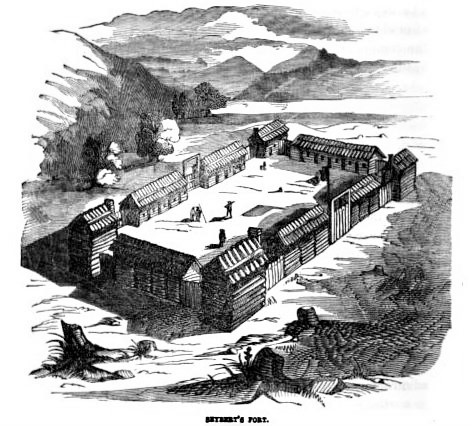
By Wills De Hass (no attribution as to wood engraving) – History of the Early Settlement and Indian Wars of Western Virginia: Embracing an Account of the Various Expeditions in the West, Previous to 1795 (https://books.google.com/books?id=Z9pBcqE_U6AC&pg=PA208#v=onepage&q&f=false), Public Domain, https://commons.wikimedia.org/w/index.php?curid=48931952
The following day, 28 April, the allied French-Indian force captured a woman and a boy, and also killed a hunter outside the walls of the fort. They then laid siege to Fort Seybert. The attackers demanded that the outnumbered defenders of the stockade surrender. After a council of war, Seybert and his subordinates acquiesced to the demands of their antagonists.
Just before the gates of the fort were opened, one of the settlers aimed his musket at Bemino. As he fired, one of his comrades knocked his arm, causing the musket ball to miss its intended target.
When the gates were opened, Bemino marched into the fort and struck Jacob Seybert in the mouth with the butt of his tomahawk, knocking several of the captain’s teeth out. Seeing their commander treated thus, the settlers fled the fort in terror.
About 15 of the settlers escaped and reached forts in the Shenandoah Valley. Seybert, who sources suggest had only three other adult men with him, had agreed to surrender the fort when promised that no harm would befall its inhabitants. Following the surrender, the Indians killed 17 to 19 of the settlers.
The raiders also secured eleven captives, one of whom was Jacob Seybert’s son. The younger Seybert described many years later what happened after the Shawnee and Lenape party took possession of the fort.
‘They bound ten, whom they conveyed without the fort, and then proceeded to massacre the others in the following manner: They seated them in a row upon a log, with an Indian standing behind each; and at a given signal, each Indian sunk his tomahawk into the head of his victim: an additional blow or two dispatched them.’
The raiders then set the fort ablaze and conveyed their captives back to the Ohio Country.
© Mark Young 2026
Sources
Encyclopedia of Historic Forts by Robert B. Roberts
https://en.wikipedia.org/wiki/Fort_Seybert

 Hellish Fiends, and Brutish Men
Leave a comment