
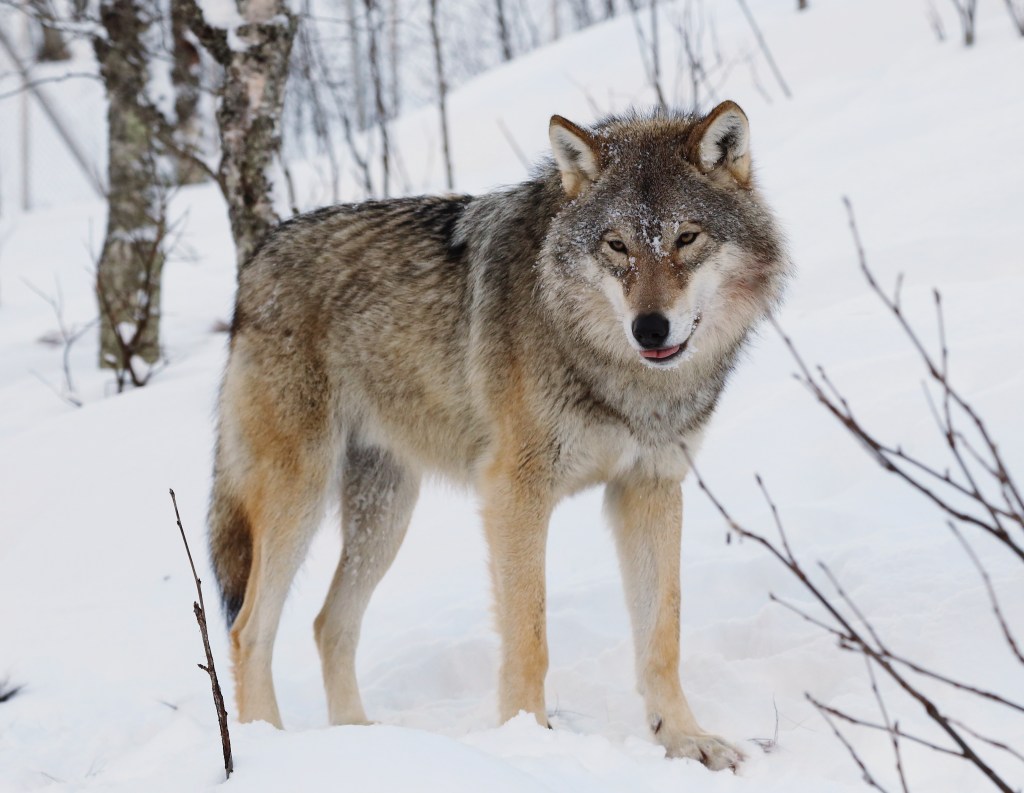
By User:Mas3cf – This file was derived from: Eurasian wolf.JPG, CC BY-SA 4.0, https://commons.wikimedia.org/w/index.php?curid=95523086
Beginning in 1880, a series of wolf attacks brought terror to the countryside north of the city of Turku, in south-west Finland. Continuing into the latter part of the following year, reports suggest that 22 children were killed by a trio of wolves.
In 1809, when Finland became an autonomous Grand Duchy in the Russian Empire, Turku became the capital, but it lost its status three years later. Turku is Finland’s oldest city, though it is unclear when it received city status. With a population of 207,000, it is Finland’s third-largest city. In 2011, it was designated European Capital of Culture (along with Tallinn, Estonia’s capital).
On the evening of 15 January, two brothers, Kalle and Ville Hörnberg, were outside their sauna in the village of Vellua, 60 miles from Turku, when a wolf raced from a nearby forest, crossed the Hörnbergs potato field, jumped a fence, and snatched Kalle up in its jaws and retreated with the struggling boy as his terrified brother ran off to alert his mother.
In 1979, the aged daughter of Ville Hörnberg recounted the family legend of the boys’ mother, who set out with a group of local men to locate her taken son.
‘Traces of blood in the snow showed the path of the wolf…half a kilometre away, Kalle’s right leg was found. It was torn off the thigh.’ Further along the trail, they found Kalle’s clothes. The searchers come across more of Kalle’s body parts, which his mother gathered up in her skirt and took home. The searchers were unable to find the wolf.
In the aftermath of the death of eight-year old Kalle, the bounty for killing a wolf was raised to 75 Finnish Marks. Three wolf hunts were launched in the nearby parish of Mynämäki, but they were all unsuccessful.
In April 1880, there were three further attacks. In the village of Viikinen, Johanna Josefina Wiik is playing outside her family’s home. She called out, ‘Mother!’ When her mother went outside, all that remained of the two-and-a-half-year-old was her foot; wolf tracks led towards the nearby forest. Although Johanna’s remains were never recovered, a funeral service was held two days later.
On the same day that little Johanna’s service was taking place, three siblings were walking to their home in Kaitarainen when they were set upon by a wolf. The oldest of the children, a twelve-year-old boy, scooped his five-year-old sister up into his arms and saved her. The third child, seven-year-old Maria Matilda, is carried off by the wolf. As with Johanna, Maria’s body is never recovered.
The following day, just six miles away from the attack on the three siblings, another family was left grief-stricken. Maria Matilda Helin was sent to collect a pail of water from a nearby spring. When her absence was noticed, and her parents looked for her, all they found was a few spots of blood and the upturned bucket. Once more, no body was recovered.
It was the middle of May when the children of crofter Jaako Latvala were playing hide-and-seek outside their home in Karviainen. Three-year-old Amanda is searching for her game-mates when a ‘big dog’ approaches. Amanda (known to her family as Mantu) does not notice until it is too late. The wolf grabbed Amanda by the neck, shook her to death, and ran off with her body. Amanda’s shoes, with her feet still inside, were recovered later.
The governor of the Province of Turku, Count Carl Magnus Creutz, tells residents of the province to kill any wolves seen in the area. Six wolf cubs were killed in Mynämäki, but the child-eating wolf remained at large.
From the summer into the autumn, more children lost their lives to the Wolves of Turku. On 3 August, Anna Sofia Lindberg and a friend were herding cattle along a road that cut through a forest when a wolf attacked. The wolf seized and killed Anna; the other girl ran off to summon help. A wooden cross nailed to a pine tree marked the spot where Anna lost her life.
In October, four-year-old Ida Karoliina Eufrosynentytär Tuominen was attacked and killed by a wolf. It was of some small relief to her family that her father managed to recover her body. The day after Ida was taken, another young girl, five-year-old Seraffia Aleksandra Granfors, was attacked and taken away in the woods near her home. Villagers searched for Seraffia for two days but came up empty-handed. As with Johanna Wiik, a funeral service was held for Seraffia.
The following week, Pauli Robert Gronröos, walking alone in a forest, is killed by a wolf; only his head and his feet are recovered. Exactly one week after Pauli’s death, Ida Elina Laakso was leading a group of her schoolmates through the hamlet of Kierla when a wolf pounced on her and dragged her into a snowbank next to a barn. Fortunately, Ida was bundled up in thick clothing to ward off the cold, and the animal was unable to hold on to the girl; it dropped her as it endeavoured to drag her away.
Alerted by the screams of her fellows, Janne Mäkilä, a local man, arrived on the scene and managed to drive the wolf away. Ida sustained a broken leg in the attack, and Janne carried the stricken girl back to her home.
Six days after Ida’s narrow escape, Juho Laiho also survived a wolf attack. With the spate of deaths, a committee was formed in Turku, and the committee hired experienced hunters and approved the use of poisoned bait. The attack on Juho Laiho is the last recorded in 1880.
During November and December, a hunter named Hintzen was tasked by the Russian Imperial Senate to hunt down the child-killing wolves. Hintzen and his force are in the field for 43 days, but are wholly unsuccessful.
Winter and spring passed quietly with no more wolf attacks. However, on 14 May 1881, the calm is broken. Juhani Wähätalo was chopping wood outside his home, his mother, watching through a window, saw a wolf pounce on her son. By the time she could get outside, Juhani had been carried away. A rescue party was soon on the trail of the boy; they only found parts of his body and also recovered his trousers. Juhani’s bereft father carves a cross and the date of Juhani’s disappearance into a boulder; it is still visible decades later.
The next day, Mathilda Josefina Heikkilä is supposed to be playing inside with her siblings, seven miles from where Juhani disappeared. Unnoticed, Mathilda has crept outside, and a wolf takes her away; her skull is all that was found of the little girl known to her family as ‘Fiinu’.
The next month, Mauritius Leppäoja is returning from a forest-side meadow with a horse, when a wolf attacks and kills him. Two men chance upon the scene and scare the wolf away. They take the boy’s body to his home.
At the end of June, the Niittymaa family are enjoying a sauna at the end of a hot afternoon. Five-year-old Gustaf decides to return home; a wolf snatches the little boy. His body is found several days later, hidden in a swamp.
In the middle of July, the Väliveräjä family are visiting relatives, when, from in front of his parents’ eyes, Johan, seven, is grabbed by a wolf and taken away. As with some of the previous victims, his shoe is found with his foot still in it. Part of his body is later recovered from a nearby swamp.
Exactly one week later, Gustaf Hartman and his younger brother leave home to go berry picking. They are surprised by a female wolf, which kills Gustaf; his brother escapes uninjured. Again, parts of Gustaf’s devoured body are found in a swamp.
On the last day of July, the Åkerman children were indoors watching their two-year-old brother, Kondrad, play outside when a wolf appeared from the road, jumped a fence, and snatched the toddler away before his siblings could react.
Three days later, Matilda and Ida Savén were taking their cows to pasture through the forest, when Mathilda, eight, was attacked and taken away by a wolf. Her father later reportedly found her partially-eaten body.
Gustaf Nummelin, aged four, was snatched in front of his mother on 15 August. The body is found uneaten 1 mile away. As with Juhani Wähätalo, Gustaf’s family carved a cross into a boulder that remained visible decades later.
Carl Forström, a seven-year-old, was tasked with herding his family’s cattle. He encountered a wolf and jumped onto a large boulder, yelling and waving his arms, as he had probably been instructed to do by his parents should he ever come across a wolf. The wolf was undisturbed by Carl’s efforts, and his body was later discovered by the boulder.
On 1 October, Carl Santala and his siblings were instructed not to leave the house while their parents were at work. Eight-year-old Carl decided to fetch a bucket of water from a nearby well. He was ambushed by a wolf and never returned home; only his clothes and a few bones were recovered.
On 31 October, Alina Kristina Johansson’s mother watched out of a window as her daughter entered the yard. The mother then noticed Alina being followed by a wolf. Alina had started to open the door to the house when the wolf pounced and dragged the six-year-old away to where two of her cubs were waiting. Most of Alina’s body was never recovered.
The last death attributed to the Wolves of Turku was that of Five-year-old Karl Grönroos, on 7 November 1881. He was playing with a pal by a sheep pen when a wolf appeared on the scene and launched an attack on the duo. The unnamed friend squirmed under a fence and made good his escape; Karl was not so lucky. His body was later found a short distance away in a ditch.
The government called in hunters from Russia and Lithuania to help kill the child-eating Wolves. On 19 November, Major Raimund Thuring was appointed to lead the campaign, along with nine Russian hunters (lukashi) hired from Pskov Oblast, near the present Estonian border. 15 soldiers were also involved in the hunt.
The hunt commenced on 10 December. The hunters were split into three groups of eight; each group consisted of three of the Pskov men and five soldiers.
It was 2 January when the hunters had their first success. Ivan Paklja, one of the Pskov lukashi, shot the female wolf in Kytöinen. It is believed that the pelt of this wolf was used as a door mat for a time before disappearing.
A male wolf, believed to be the mate of the female shot at the beginning of January, was killed on 14 January. The wolf was either shot by a crofter’s son or was poisoned; stories differ. Over the winter, 12 wolves were shot in the area. After the male and female believed to be responsible for the spate of attacks were killed, there were no more attacks.
On 27 October 2005, Erkki Pulliainen, a wolf specialist with the International Union for the Conservation of Nature, in an interview with the Finnish newspaper Demari, hypothesised that one of the Turku wolves was a wolf-dog Hybrid.
Eirik Granqvist wrote an article in the Helsingin Sanomat rebutting Pulliainen’s claim. He said that both of the wolves that remained, one in the hunting museum in Riihimäki and the second at St. Olaf’s Secondary School in Turku, had been positively identified as wolves.
© Mark Young 2026
Sources
https://chloewells.medium.com/the-child-eating-wolves-of-turku-454352b552f3#
https://en.wikipedia.org/wiki/Wolf

 Hellish Fiends, and Brutish Men
Leave a comment