
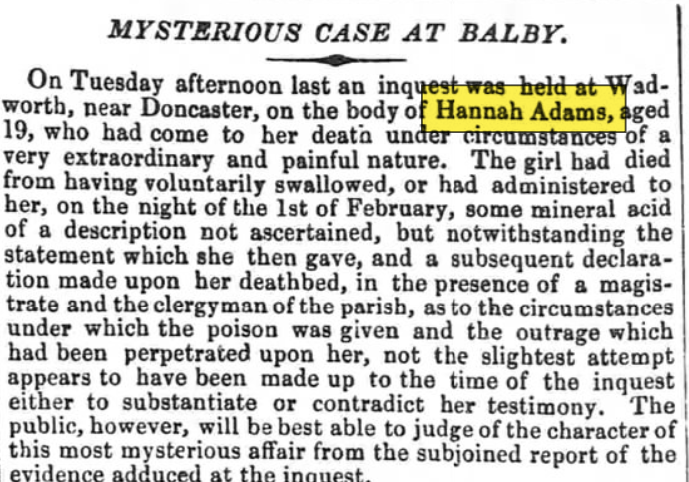
On Tuesday, 22 March 1852, an inquest was held in the South Yorkshire village of Wadworth, on the body of 19-year-old Hannah Adams, ‘who had come to her death under circumstances of a very extraordinary and painful nature.’
Hannah Adams was employed as a housemaid by Mrs. Shepphard, in the village of Balby, a short distance from Wadworth, where the inquest took place. On Sunday, 1 February, Hannah, accompanied by Anne Bywater, Mrs. Shepphard’s cook, attended church. After the service concluded, the two went for a walk. Anne, going ahead, left her colleague in conversation with a man she didn’t recognise.
Later that evening, Anne was in the kitchen with Hannah when the latter went outside without saying where she was going. About half an hour after Hannah lad left the kitchen, John Dykes, another member of the household staff, came in from the stableyard, which was out the back of the kitchen, and chatted with Anne Bywater.
Dykes waited in the kitchen for about 15 minutes, but Hannah Adams still had not returned, so he went out to check the back gate. Noting that the bar of the gate was up, he decided that Hannah could not have exited that way. Apparently unconcerned as to what had become of the missing housemaid, John Dykes headed home.
Mrs. Shepphard, apparently alarmed by Hannah’s continued absence, sent Anne Bywater to retrieve Dykes. Dykes, in concert with Balby Constable John Race, started a search for the missing girl.
Dykes later told the inquest that it had been a bright moonlit night, and armed with a lantern, he and Race searched the buildings and grounds, as well as an adjoining meadow. They called out to Hannah several times, but to no avail.
Constable Race and Dykes then visited Hannah’s parents’ home in nearby Wadworth, but they hadn’t seen their daughter that day. As they reached the bottom of Wadworth Hill, on their return to Balby, they met a woman who passed them without speaking.
Dykes called out: ‘Isn’t that Hannah?’ The woman averred that it was. Dykes approached her and asked where she had been. Hannah responded that she had left the kitchen to visit the ‘privy’. As she left the privy, ’Two men got hold of me…and took me across into a fallow field, where they attempted to take liberties with me, and poured some stuff down my throat.’ She added that the men threatened to kill her and forced her to hand over 6d, which was all the money she had on her.
Dykes asked Hannah if she had heard him calling. She said that she had not. He told the subsequent inquest that the housemaid’s dress was dirty, she reported that her assailants tore her ‘cap to pieces’. She wore an apron on her head. Dykes didn’t notice any rents in her clothing, but observed that her boots and stockings were thick with clay. Instead of taking Hannah, who was trembling with the cold, to her parents’ home, they returned to Balby.
Hannah said that the men had taken her from the field, where they dragged her to Cooper’s Lane, where they left her. One of the men said: ‘Go home, d..n thee, and keep what thou hast gotten.’
Hannah showed Dykes, who reckoned she ‘was like a tipsy woman’, a pocket handkerchief which she said had been burned by the substance the men had poured into her mouth. When they arrived back at Mrs. Shepphard’s, Hannah was put to bed, presumably in the care of the lady of the house or one of the other members of the household staff. The local doctor was not summoned for another four days.
The next day, John Dykes examined the ground where Hannah Adams alleged she was attacked. He went over the ploughed field but could find no sign of any struggle. Dykes told the inquest that he could not see any of the footprints left by himself and Constable Race the previous evening. He observed that the gravel in the yard and garden was not very soft. No witness at the inquest testified to the weather conditions on the evening of 1 February.
As noted above, it was on 5 February that Dr William Dixon was asked to attend the stricken housemaid. He told the inquest that when he examined Hannah, there was ‘saliva running from her mouth, and there were marks of burning upon her chin and her mouth, which appeared as if they had been produced by some mineral acid.’ Dr. Dixon added that Hannah’s dress and cap strings were discoloured as if they had been burned. She told the doctor how she had been grabbed after leaving the privy and dragged into the field, where her two assailants forced the liquid into her mouth.
Dixon neglected to give Hannah a physical examination and told her that ‘the tale she told me was a most extraordinary one, and that I really did not believe it.’ Hannah responded that the story she had told was the truth.
On his next visit, Dixon ‘exhorted her to speak the truth.’ Again, Hannah stuck with her story. The surgeon asked if she had any reason to harm herself. Hannah repeated that she did not take it herself, and that her two assailants had forced it upon her.
Dixon reported that Hannah refused to take the medicine that he prescribed, and ‘seemingly did not wish to get better. She also scrupulously avoided food.’ Dixon went on to say, ‘The cause of death I attribute to some mineral acid. I judged so from the symptoms I observed, and the marks of discolouration from the lips to the chin.’
At that point, West Riding Magistrate R.J. Coulman asked: ‘Does that tend to corroborate the girl’s statement, that she had the liquor forced into her mouth, than to induce the supposition that she had taken it of her own accord?’
Dixon prevaricated. ‘Well, sir, it might or might not. She might have allowed some of the liquid to run out of her mouth, even if she had taken it of her own accord.’ It was evident to all present that Dr. Dixon believed that Hannah Adams had made up the story about the assault.
The coroner asked the witness: ‘Would a person be likely to take such a poison…in order to commit suicide?’ It was believed that vitriol was the substance Hannah Adams ingested. During his testimony, John Dykes had said there was no vitriol kept at the Shepphards’ residence.
The doctor doubted it, saying that ‘much readier poisons might be procured to effect that object.’
R.J. Coulman took the stand after Dr. Dixon. He stated that on 15 March, he visited Thomas Adams’ house and spoke to Hannah. He testified that she told the same story, adding that she had begged the men not to kill her, ‘you have done plenty to me already.’ The second man reportedly said, ‘Let her go, she’s some poor body’s bairn.’
Reverend Charles Ward, vicar of Wadworth, was with Coulman when he took Hannah’s testimony, and he corroborated everything the magistrate had said. After taking Hannah’s statement, Coulman read it back to her, and Hannah said it was correct and signed it.
After Dr. Dixon had seemingly washed his hands of his former patient, Charles Ducker Fenton, M.D visited Hannah. He stated that she was vomiting constantly and ‘threw up large portions of the…lining of the stomach.’ He added that he didn’t believe the patient to be pregnant. Like his colleague Dixon, he attributed the cause of death to poisoning, but likewise couldn’t say who had administered it.
Balby Constable John Race* testified, but had little to add. He confessed that he had not seen Hannah Adams since the night of 1 February. At this point, the coroner upbraided Race and John Dykes ‘for the unfeeling conduct which they had exhibited towards the girl, in allowing her to proceed home by herself, when they heard her story, and saw the state in which she was, and he considered the constable’s conduct in having made no search or inquiry after the men, was most gross and reprehensible.’
As he summed up, the coroner said that there was little doubt that Hannah Adams had died by poisoning, adding that the idea that she had committed suicide ‘was surrounded by so many improbabilities that it could scarcely be entertained’, despite what Dr. Dixon believed. The coroner counselled the jury to adjourn the case so that further investigations could be carried out, and ‘some clearer and more satisfactory testimony could not be obtained.’
To the coroner, it was clear that the jury had two choices: either bring in a verdict or adjourn the case and allow a thorough investigation. He added that the first option was the easiest, ‘and perhaps save them some further trouble, but if they chose the second course, and adjourned the inquiry, they would be satisfying their own consciences and doing what might be conducive to public justice.’
When the jury returned from their consultation, they showed little sign of having troubled consciences and returned a verdict ‘that the deceased, Hannah Adams, had died from the effects of a mineral acid having been received into her stomach, but whether the same had been taken of her own accord, or whether it had forcibly, illegally, and feloniously been administered to her thee was no evidence to determine.’
In the aftermath of the inquest, the newspapers were certain that the investigation was wholly inadequate, and the idea that Hannah Adams died by suicide was unsupported by the evidence.
*Also seen as George Race in the same article.
© Mark Young 2026
Source

 Hellish Fiends, and Brutish Men
Leave a comment