
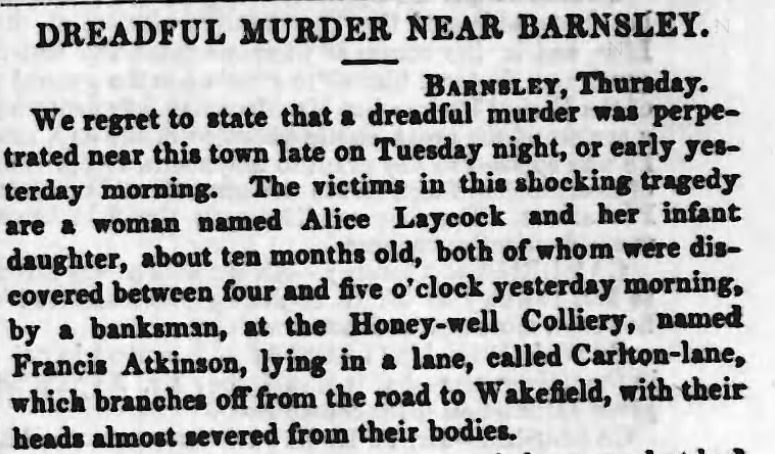
Weekly Examiner, Huddersfield, West Yorkshire. 27/03/1852
Early on the morning of Wednesday, 24 March 1852, Francis Atkinson was walking to work at a colliery in the South Yorkshire village of Smithies, when, passing along Carlton Lane, he discovered the bodies of a woman and a baby lying in an embrace, ‘weltering in a pool of blood.’
Atkinson realised he knew who the woman was. Pulling himself together, he ran the short distance to the home of Joseph Laycock. Laycock was in bed when Atkinson reached the house. The colliery worker told the other man that the bodies of his sister and her young daughter were lying in Carlton Lane with their throats cut.
Joseph Laycock immediately raced to the scene, where he found his sister and niece ‘quite stiff and cold.’ Annis Laycock was about twenty-three years old, the estranged younger sister of Joseph. She lived a stone’s throw from where her body and that of her 10-month-old baby, Emily, were found by Francis Atkinson.
Baby Emily’s throat had been cut ‘effectually across the arteries.’ It was the belief of the surgeon called in by the superintending constable that she had died instantly. Annis’ death had been more painful and drawn out. Her windpipe had been cut, but other injuries suggested that it was only on the fifth attempt that the fatal wound had been delivered. Annis’ hands were both drawn by her chest; in her right hand was a razor.
Both of the bodies were removed to the nearby Woodman Inn, where the surgeon, Mr. Wainwright, examined them. Apart from the injuries to her throat, Annis sported a pair of black eyes and other injuries to her face.
Joseph Laycock reported that his sister was married to a railway labourer named Smith; he was unsure whether the man’s first name was George or Thomas. Annis subsequently learned that Smith was already married. She left her husband, taking her baby, Emily, with her.
When the bodies were discovered in Carlton Lane, Annis was living a short distance away with a damask weaver named James Gledhill. Gledhill had a reputation in the area as a poacher.
As well as a poacher, Gledhill was a violent man, as witnesses at the inquest held at the Woodman Inn the following Saturday would attest. Thomas Lee chaired the inquest.
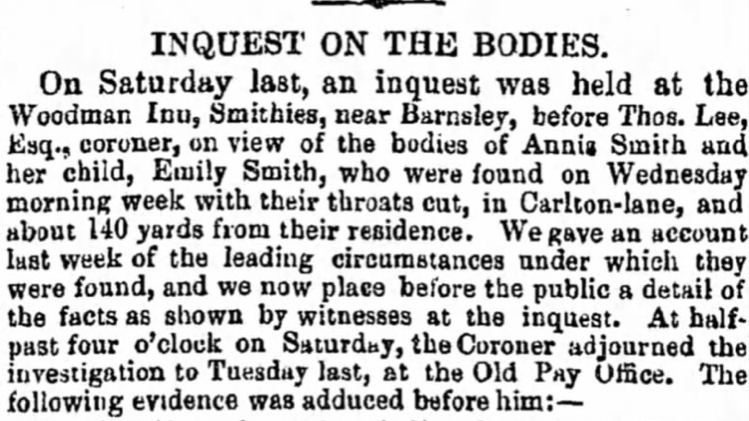
The Leeds Mercury. 03/04/1852
Giving evidence, Francis Atkinson stated that when he found the bodies, Annis’ clothing was unruffled. Following Atkinson, Joseph Laycock testified that Emily’s thighs were bloody, and a ’shawl near the child was saturated with blood.’ He observed that Annis clutched a ‘razor in her right hand, which was open and bloody. The blood appeared to be dry.’
Charles Green, the constable of Monk Bretton, followed Joseph Laycock. He told the inquest that both of the bodies had had their throats cut, he had the bodies removed to the Woodman Inn and went to inform his superior.
A neighbour of Annis Laycock and James Gledhill, with the singular name of Willougby Thickett, testified that he had heard Annis and Gledhill arguing at around 10 o’clock on the Monday evening, two days before the bodies were discovered. He watched from his front door, Gledhill ’Turn Annis out’. Annis had only gone a short distance when Gledhill brought her back, ‘and told her to pack up and leave his house.’ Annis responded: ‘Give me my child, that is all I want.’ After Annis had retrieved Emily, Gledhill ’turned her out a second time.’ Willoughby Thickett watched as Annis walked away, quickly pursued by the enraged James Gledhill. ‘He followed her and kicked her very hard seven or eight times, besides hitting her with his fists.’ Thickett’s wife, Amelia, pleaded with Gledhill to stop. Gledhill turned and struck Amelia. Willoughby Thickett ’then interfered, and he struck me.’ Thickett responded by punching Gledhill in the face. The two then engaged in a bout of wrestling on the ground. Thickett added that: ‘his nose bled very profusely. There were marks of blood beside our door until yesterday (Friday), when the rain washed it off.’
Amelia Thickett followed her husband onto the stand and corroborated what he had said. She added that she had never heard the pair argue before. James Gledhill was ‘very drunk’, she emphasised.
The following night, Amelia was awoken by James Gledhill talking in the yard. ‘I got up and went to the window,’ she said. Adding she heard Gledhill say to Annis, ‘Will you come in, and let’s have our supper; if you won’t come in I shall be like to go in and go to bed’. Amelia saw Gledhill go inside before re-emerging a few moments later and heading to his sister’s house, before once more returning home. Amelia noted that she never saw Gledhill leave his yard the rest of the evening. She had seen Annis on Tuesday, ‘Her face appeared to be very much bruised, and she had two black eyes. She was a spirited, resolute woman, and would not submit to anything.’
On Tuesday night, Mary Ann Sharp, another neighbour of Annis, was suffering from a severe toothache. Around midnight, Mary Ann told the inquest the clock had just struck the hour, when, ‘I heard a hurried footstep come round the corner of the buildings, and stop opposite my door. Immediately I heard an unnatural cry, as of a child, and, by the sound, I thought that the person who was with it had put their hands against its mouth to stop its breath.’ The Sharps had a handcart outside their front door, and Mary Ann believed she heard someone lifting it. Fearing the theft of the handcart, she threw the bedroom window open and saw Annis disappearing around the corner into Carlton Lane with baby Emily tucked under her right arm. Mary Ann added that before she looked out the window, she heard Annis cry ‘bitterly.’
The last witness of the first day of the inquest was another neighbour, Sarah Bartle, who reported that a distressed Annis visited her late on Monday evening. ‘Open the door, Sarah, for I am a dead woman.’ Sarah let Annis, who was carrying Emily in her arms, inside. ‘Lock the door and put the candle out,’ she instructed.
Annis told her friend that earlier that day, she had been to nearby Barnsley with James Gledhill, and they had an argument, and he had ‘ill-used her.’ The emotional Annis told Sarah, ‘If I could clap my hands upon anything to cut my child’s throat and my own, I would do so.’ The horrified Sarah Bartle answered that such an act was: ‘a very great sin.’
Annis responded that she would slit Gledhill’s throat if he didn’t mind himself. Sarah asked Annis how she could contemplate taking the life of her daughter. Annis responded that there was no one else to look after Emily, ‘and it(Emily) would go with me.’ While Annis was still at Sarah’s house, she kissed Emily and said, ‘Bless thee, but thou shalt be in heaven before to-morrow night at this time.’ Annis turned to Sarah and apologised for keeping her, ‘we shall disturb nobody anymore.’ She added that she wished her father were dead ‘as she knew it would grieve him…she had brought disgrace upon herself and her whole family.’ Sarah Bartle’s testimony concluded without stating whether she had taken any action to prevent Annis from carrying out her plans. There was no indication that Sarah had alerted Annis’ father, who might have averted the tragedy that was set in motion.
After Sarah Bartle’s testimony, the inquest was adjourned till the following Tuesday. On resumption, the hearing would move to the Old Pay Office in nearby Barnsley.
Rose Scargill, another neighbour, was the second witness to give testimony at the resumption of the inquest. Selina Bartle added little that the jury had not heard before, informing them that there was blood on the Sharps’ handcart on Thursday.
Rose Scargill attested that she paid a visit to Gledhill’s on Tuesday evening. Annis and Emily were in the house alone; James Gledhill was drinking in the Woodman Inn. Annis began to say what a scandal it was to have two black eyes, she added: ‘Jim (Gledhill) will find me and my child a corpse at his feet in the morning.’ Rose told her not to think that way. Annis responded that her family had all turned against her, ‘and she could not bear it.’ She worried that if Gledhill threw her out of his house, she would have nowhere to go.
Rose asked Annis how she could do anything to ‘this little darling’. Annis responded, ‘I shall not leave it behind.’
Before leaving the stand, Rose Scargill testified that she had never heard Annis and Gledhill arguing.
In her deposition, Mary Shaw, who lived next door to the Gledhill residence, said that Gledhill had entered her house on the Monday night, looking for Annis. He ‘was not sober’ as he ascended the stairs searching for Annis. Mary Shaw alleged that he said: ‘if she (Annis) deceived him once she should not twice.’ Not finding Annis at the Shaws’, Gledhill left.
The following morning, Mary Shaw went to the home of Gledhill’s sister Anne Swift, where she found Annis and Emily ‘laid on the bed with their clothes on.’ Annis was in a subdued mood and ‘Called my attention to her black eyes and said I shall cut my throat and the child’s too, and James Gledhill will be in York (Castle Prison) before Saturday.’ As with Rose Scargill, Mary Shaw stated that she had never known the couple to have cross words.
Charles Hall reported seeing James Gledhill at the Woodman Inn on both Monday and Tuesday nights. On Tuesday, Gledhill had helped Hall slaughter a pig.
Henry Scargill added that he had gone to see Gledhill on Monday night, after hearing him and Annis arguing. Scargill stated that he slept at Gledhill’s, perhaps concerned about how the circumstances would play out.
Johnathan Whittaker saw Gledhill at the Woodman Inn on Tuesday night. He noticed that Gledhill had a black eye. Gledhill answered: ‘Yes, me and my wife have been fighting. I gave her a good hiding last night, and feel grieved about it.’
Whittaker next saw Gledhill on Wednesday morning as the former made his way to work. Gledhill was crying and said, ‘Our Annis has cut her own throat and the child’s.’ The clearly bereftGledhill added: ’They are bringing them down on boards (to the Woodman Inn), and for two pins I would cut my own throat.’
When William Green, Superintendent of Police for the Barnsley district, took the stand, he described viewing the bodies at the Woodman Inn before looking over the crime scene. He went to Gledhill’s home, where he noticed blood spots on the doorstep and a large one inside near the stairs. Inside the bedroom, he saw more blood, ‘about the size of a crown piece, upon a sheet and blanket, and underneath the mattress I found a razor case without razor. I…next searched the prisoner, and found upon one of his shirt sleeves a quantity of blood reaching from the wrist to the shoulder. I told him to be careful what he said, as I charged him with being the murderer or being connected therewith.’
According to Green, Gledhill answered: ’Nay, I have nought to do with this job, I am innocent, and never did any thing at her except thump her a bit.’ Both at the inn and when he was being transported to Barnsley, Gledhill repeatedthat ‘this is a bad job.’ He admitted that he had beaten Annis on Monday night, in his words, he had ‘given her a good thumping.’ He ascribed the blood on his shirt to being caused by ‘a chap named Thickett hit me over the nose and caused it.’
Green then took possession of Gledhill’s clothes; he found a second bloody shirt. That Blood, Gledhill said, had got on his shirt when he helped Charles Hall butcher a pig on Saturday. The Superintendent then produced both bloodstained shirts for the jury’s review.
It was then time for Thomas Wainwright, the surgeon, to give his evidence. He stated that when he examined the bodies, he found that Emily’s chemise had been cut into two by a sharp instrument. He added that the body showed no signs of violence except for the cuts on her throat.
Wainwright went on to say: ‘One of the cuts commencing immediately after the angle of the left jaw, extending completely downwards across the throat to the extent of about three inches, dividing in its course the integument, jugular vein, carotid artery, muscle, and nearly through the windpipe…forming a wound sufficient to cause death.’
Wainwright testified that, in the position of the bodies, Annis could have inflicted the wounds.He stated that Emily would have died almost immediately. When he examined Annis, Wainwright found that she was severely bruised, as several previous witnesses had attested; her throat bore ‘a clean incised wound, about two inches above the collar bone, extending about two inches and a quarter across the neck…which had no doubt been the cause of death.’ Wainwright informed the assembly that there were four other wounds to Annis’ throat. ’Three of them being very superficial, the fourth rather deeper.’
When pushed further, the surgeon conceded ‘I should think that she was capable of committing that cut upon herself. She must have been sometime before she expired.’ Taking a deep breath, Wairight continued: ‘I am decidedly of opinion that there is no wound but what might have been inflicted by herself. I cannot account for the position in which she had her hands, and the position of the razor. Both her hands and her arms were very bloody. If the murder of the child had been perpetrated in the house, the blood from the wound could not have been staunched by a shawl or cloth.’
Thomas Wainwright was the last witness to testify when he stepped down, Coroner Thomas Lee summed up the evidence and sent the jury out to consider their verdict.
The jury returned after three quarters of an hour and delivered their verdict: ’That the deceased Annis Smith, and Emily Smith, were found with their throats cut quite dead, but by whom the act was done there is not sufficient evidence to show.’
It isn’t easy to see how, after hearing all the evidence, the jury arrived at the verdict they reached. Presumably, they did not want to label Annis as guilty of filicide. Despite the jury’s verdict, James Gledhill was released from custody following the conclusion of the inquest.
© Mark Young 2026
Sources
https://www.newspapers.com/article/the-leeds-mercury-horrible-murder/185822620/
https://www.newspapers.com/article/lloyds-weekly-newspaper-supposed-murder/185821224/
https://www.newspapers.com/article/the-leeds-mercury-inquest-on-the-bodies/185821835/
https://www.newspapers.com/article/weekly-examiner-gledhill/185822391/

 Hellish Fiends, and Brutish Men
Leave a comment