
On Sunday, 12 March 1864, a detachment of 50 men from the 30th Wisconsin Infantry, under the command of Major Cyrus Wilson, surrounded a tobacco barn at Webster, Kentucky, and after a brief firefight in which three members of the infantry were slightly, and one mortally wounded, captured the notorious Confederate guerrilla Sue Monday (Mundy, Munday), along with Henry Medkiff ( or, Metcalf) and the grieviously wounded Henry C. Magruder. Magruder had received wounds to his back and arm previously; in addition, he was shot through the lungs during his capture.
During the early autumn of 1864, as the American Civil War continued to rage, the name ‘Sue Monday’ began to appear in newspapers across the United States. The Patriot-News, a Harrisburg, Pennsylvania, Journal, informed its readership that ‘The second officer of a band of Kentucky guerrillas is a woman named Sue Monday. She dresses in male attire…upon her head she wears a jaunty plumed hat, beneath which escapes a wealth of dark brown hair, falling around and down her shoulders in luxuriant curls.’
The paper added that Sue Monday’s name was becoming widely known, ‘and to the ladies it is always associated with horror.’ According to Georgia’s Daily Columbus Enquirer, towards the end of November 1864, ‘she robbed a young lady of Harrodsburg of her watch and chain. If the citizens had not so unceremoniously expelled the thieving band from the town, in all probability, this she devil in pantaloons would have paid her respects to all of the ladies of the place and robbed them of their jewelry and valuables. She is a dangerous character…we hope that she may soon be captured and placed in a position that will prevent her unlady-like exploits.’
Earlier in the month, the same gang of guerrillas had raided the stable of Kentucky horse trader R.A. Alexander and made off with Asteroid, Alexander’s ‘pet horse’. Happily, Asteroid was soon recovered. In the first reports of the theft, Monday’s first name was rendered as ‘Joe’.
Four Confederate guerrillas, ‘two whereof called themselves Confederate captains,’ captured on the Cumberland River, were removed from the Exchange Barracks at Louisville, and executed by a Union firing squad, in reprisal for the murder of a mail carrier, and theft of the mail ‘by guerrillas under a notorious woman named Sue Monday.’
Also in November, under the heading: ‘Feindish Acts of the Guerillas in Kentucky-The Notorious Sue Munday at her Bloody Work’, The Daily Evening Express (Lancaster, Pa) reported the murder of a ‘Mr. Harper,’ at his property two miles south of Midway, Kentucky. The guerrillas made the old gentleman a prisoner, and without the slightest provocation murdered their victim in the most cowardly and brutal manner…Mr. Harper was a Union man; this was the only excuse the outlaws had for this inhuman outrage. It does seem that this Sue Monday is lost to every womanly instinct, her heart wholly corrupted and her nature fiendish; for she rejoices in acts of cold blood and every species of crime.’
In July 1864, Union General Stephen G. Burbridge, the officer in charge of the District of Kentucky, issued Order No.59, which demanded ‘Whenever an unarmed Union citizen is murdered, four guerrillas will be selected from the prison and publicly shot to death at the most convenient place near the scene of the outrages.’
The day after the murder of Harper, following an order issued by Gen. Burbridge, four Guerrillas were escorted from the prison at Wilmington by a detachment of soldiers to the site of the previous day’s murder, where a firing squad executed them.
The following month, ’Sue Munday’s gang of guerrillas, made a dash into the town of Springfield, Ky., The raiders rode their horses into homes and threatened residents with loaded pistols. They robbed the citizens of Springfield of around $2000, as well as ‘a large number of fine watches, both gold and Silver.’ They paid a visit to the home of John Wetherton, ‘a good citizen and an unflinching Union man’, and ‘shot him in cold blood.’
On January 10, 1865, The Louisville Journal printed an article which was published in several other newspapers in the following weeks, stating that: ‘We have it on good authority that Sue Monday is not a female, as is generally believed, but is in reality Jerome Clark, a son of Hector M. Clark, of Simpson County Ky.,…also cousin to Tandy Clark, now in the State Prison for robbing the mails.’
The Journal informed its readers that Clark (Actually Marcellus Jerome Clarke) had ridden with the Confederate Brigadier General John Hunt Morgan. When Morgan was killed on September 4, 1864, Clarke established his guerrilla unit.
George Dennison Prentice, the editor of the Louisville Journal, is credited with the creation of Sue Monday, basing her on the exploits of Clarke and his men. Certainly, Sue Monday first appeared in newsprint in the weeks after the creation of Clarke’s guerrillas.
Also in January, it was reported that Sue Monday had been badly wounded in the town of Bardstown, Kentucky. According to the Louisville Journal, Guerrillas led by ‘a scoundrel named Marion, with a small squad of desperadoes,’ attacked Samuel’s Station, burning several railway cars, the railway trestle, and a pile of ‘sawed wood collected there.’ An attempt to capture a train failed.
Around the same time, an outlaw named John Robinson was captured by a party of Union soldiers and transported to Bardstown’s jail. In an attempt to secure Robinson’s release ‘a concentration of the guerrilla bands…headed by Captains Pratt and Magruder…made an attack on Bardstown.’
In an attempt to draw the Union soldiers garrisoned in the town out, the guerrillas set fire to the railroad depot, hoping that the fire would prove enough of a diversion to allow them to reach the jail and release Robinson.
The fire was prevented from spreading. Magruder and Pratt rode their horses up and down the street, urging their men on in their sallies towards the jail. Soldiers stationed in the courthouse lay down a withering fire.
Lieutenant Hancock of the 34th Kentucky Volunteers, with a handful of men, charged the Guerrillas, driving them from Bardstown. Captain Pratt was shot and succumbed to his wounds early the following morning. A guerrilla named Pat Ball was also killed in the attack by Hancock’s men. ‘Sue Mundy and the scoundrel Marion were both severely wounded, and removed to places of safety by their friends.’ It seems doubtful that Sue Monday was severely wounded at Bardstown, for that name would soon be in the headlines once more.
In their haste to get away from Bardstown, the guerrillas left four horses behind. Within the ruins of the burnt-out railway depot, the body of a young citizen of Springfield, identified only as Stanbury, was discovered.
At Springfield, on 27 January, ’Sue Munday’s guerrilla band’ surprised and attacked a party of 117 discharged Union soldiers; they captured and killed fourteen of their number, supposedly in retribution for the execution of one of their comrades a few days earlier.
On the same day that the guerrillas killed the discharged soldiers at Springfield, just outside of Bardstown, Captain Berry, a one-armed officer with Sue Monday’s force, was killed when leading five of his followers in an attack on the town.
Rumours in the press abounded that the notorious Confederate guerrilla William C. Quantrill, the man who led the attack on the abolitionist stronghold of Lawrence, Kansas, in August 1863, was aiding the guerrillas around Bardstown.
The news of the capture of Sue Monday, Henry Magruder and Henry Medkiff, in Mr. Cox’s tobacco barn, began to appear in the newspapers on Monday, 14 March. On receiving intelligence regarding the whereabouts of the three guerrillas, the men of the 30th Wisconsin Infantry were dispatched from Louisville aboard the steamer Grey Eagle.
They reached their destination and quickly encircled Cox’s barn. The barn door was broken down, and Sue Monday fired two pistols as the soldiers entered the barn. Four of the infantrymen were shot; ‘their names are, John A. Robbins, Company H, gunshot in the bowels, which passed through; John G. White, Company F, wounded in upper part of the right lung, ball still in his body; W.A Wadsworth, Company A, wounded in left ankle; another of the 30th Wisconsin was slightly wounded.’ The men were transported back to the barracks hospital at Louisville, where one man, either White or Robbins, succumbed to their injuries.
The three guerrillas would only agree to surrender as prisoners of war; terms were agreed to, and the men were transported back to Louisville aboard the Grey Eagle. ‘Sue Mundy, or Jerome Clark, is a rosy-cheeked boy, with dark eyes and a scowling brow. Medkiff is a fine, stalwart specimen of humanity…he has led a wild life, and we trust that he will expiate his many crimes upon the gallows before many days.’
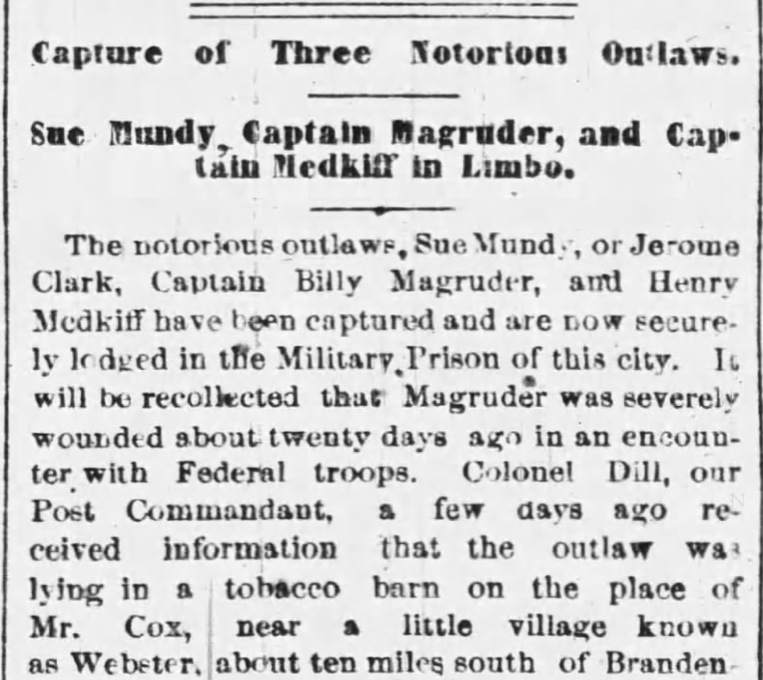
The newspapers added that both Clarke and Medkiff were shackled and watched closely on their journey to Louisville, while Magruder suffered greatly from his wounds and was not expected to last the night.
Marcellus Jerome Clarke (whose first name was given as both Gideon, Marcus, and Jeremiah in various reports) was given little time to prepare his defence; his trial was held before a Military Commission on Tuesday, March 15, the day after he arrived in Louisville. Witnesses were swiftly summoned and provided evidence of two murders and the derailment of a train, which they alleged Clarke was involved in.
Clarke was swiftly convicted and sentenced to be hanged at 4 pm the following day. A sentence that Major-General J.M. Palmer, commander of the district, approved. The Reverend Joseph C. Talbot, of St. John’s Episcopal Church, acted as spiritual advisor to the condemned man.
The Louisville Journal asserted that although Clarke knew he was to be hanged, he believed he had a few weeks to prepare for his date with the executioner. The Rev. Talbot disabused him of that belief, telling him that he would be hanged ‘in a few hours.’
Apparently, not only did Clarke not realise how little time he had left, but he had also formed the idea that a firing squad would execute him. Once more, the reverend had to set the record straight.
The method of execution set Clarke back on his heels, and he took a few minutes to compose himself. Once he had come to terms with his fate, he asked the Rev. Talbot to pray with him. An hour before his scheduled execution, Talbot baptised him.
Clarke then asked that the reverend write letters ‘to his sister, aunt, cousin, and a young lady of this state (Kentucky), having a lock of hair cut off and placed in each letter.’
While with the Rev. Talbot, Clarke insisted that he was a Confederate soldier, and not an irregular. He denied most of the crimes with which he had been convicted, instead placing the blame on ‘Marion and his men’. He maintained that he held the rank of captain in the Confederate Army, having been commissioned by Colonel Jack Allen of the 3rd Regiment, Kentucky Cavalry.
Clarke asked that when his body was removed from the gallows, it would be transported to his aunt in Franklin, Kentucky, and he would be laid to rest next to his mother and father, in his Confederate uniform.
Clarke, accompanied by the Rev. Talbot, was transported by carriage to the place of executions. Captain George Swope of the 5th Indiana Regiment, acting as Provost Marshal, conducted Clarke to the scaffold, where he knelt in prayer alongside Reverend Talbot.
After the two men had first finished the prayer, Captain Swope read out the charges to Clarke. The prisoner paid little heed to Swope, according to the Louisville Journal, ‘his eyes were half closed, and his lips continually in motion, evidently offering up his last petition to God. “Lord have mercy upon my poor soul,” seemed, from the motion of his lips, to be his prayer.’
When asked if he had any last words, Clarke turned to Talbot and said in a low voice: ‘I am a regular Confederate soldier, and have served in the Confederate army four years. I…belonged to Gen.Morgan’s command when he entered Kentucky. I have…taken many prisoners and have always treated them kindly. I was wounded at Cynthiana…I could prove that I’m a regular Confederate soldier, and I hope in and die for the Confederate cause.’
After he had finished speaking, a white cap was placed over his face, and the noose was placed around his neck. When the trap was sprung in the parlance of the times, Marcellus Jerome Clarke died hard.
Once more, the Louisville Journal: ‘the fall was not more than three feet, and did not break his neck, and he choked to death. We have seen a great many persons hung, but never before did we witness such hard struggles and convulsions…He was left hanging some twenty minutes before he was cut down. Immediately a crowd gathered around the body, some trying to cut off a button, others snatching at the cord to secure a piece as a memento.’
In its piece on the execution of Clarke, the Journal included the letter that the Rev. Talbot had written on Clarke’s behalf to the unnamed ‘young lady,’: ‘My Dear: I have to inform you of the sad fate that awaits your true friend. I am to suffer death this afternoon at 4 o’clock. ***I send you, from my chains, a message of true love; and as I stand on the brink of the grave, I tell you I do truly, and fondly, and forever love you. I am, very truly, yours, M. JEROME CLARK.’
When he was hanged on the afternoon of 15 March 1865, Marcellus Jerome Clarke was twenty years old.
Henry C. Magruder, captured alongside Clarke in Cox’s barn, survived his wounds. During his convalescence, he wrote a memoir, which Major Cyrus Wilson, the officer in charge of the detachment that captured him, published. In it, he claimed to be the real inspiration behind the fictitious Sue Monday.
Marguder, a brutal man living in brutal times, was tried in September 1865. He was found guilty of 8 murders and acting as a guerrilla fighter. He had been charged with 17 murders, intent to kill and war rape.
Marguder was hanged at Louisville on 20 October. While awaiting his destiny, he converted to Catholicism. As he was being escorted to the gallows, Magruder allegedly stated: ‘It is hard, but maybe it is fair.’
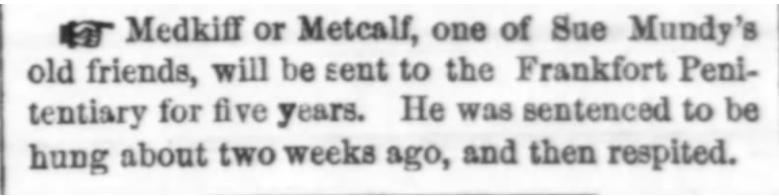
Henry Medkiff, the last of the three Confederate guerrillas captured in the tobacco barn, was sentenced to be hanged in May 1865. He had his sentence respited and was sent to Frankfort Penitentiary for five years.
© Mark Young 2025
Sources
https://en.wikipedia.org/wiki/Marcellus_Jerome_Clarke
https://en.wikipedia.org/wiki/John_Hunt_Morgan
https://en.wikipedia.org/wiki/Henry_C._Magruder
https://www.newspapers.com/image/1141109518/?match=1&terms=%22Sue%20Monday%22
https://www.newspapers.com/image/566743237/?match=1&terms=%22Sue%20Monday%22
https://www.newspapers.com/article/harrisburg-telegraph-bardstown-killings/181130782/
https://www.newspapers.com/article/the-courier-journal-berry-killed/181130942/
https://www.newspapers.com/article/the-evansville-daily-journal-sue-mundy-w/181131272/
https://www.newspapers.com/article/louisville-weekly-journal-wounded-soldie/181635780/
https://www.newspapers.com/article/louisville-weekly-journal-the-capture-of/181635975/
https://www.newspapers.com/article/the-weekly-vincennes-western-sun-capture/181636201/
https://www.newspapers.com/image/836536989/?fcfToken=eyJhbGciOiJIUzI1NiIsInR5cCI6IkpXVCJ9.eyJmcmVlLXZpZXctaWQiOjgzNjUzNjk4OSwiaWF0IjoxNzU5MDUwMDAwLCJleHAiOjE3NTkxMzY0MDB9.XblYQi-Egy7NBRoPXYxz4fcklaFWwJc9Y8IIMA7ML7M
https://www.newspapers.com/article/the-courier-journal-mundy-magruder-and/181636815/
https://www.newspapers.com/article/louisville-weekly-journal-medkiff-respit/181636910/

 Hellish Fiends, and Brutish Men
Leave a comment