
‘
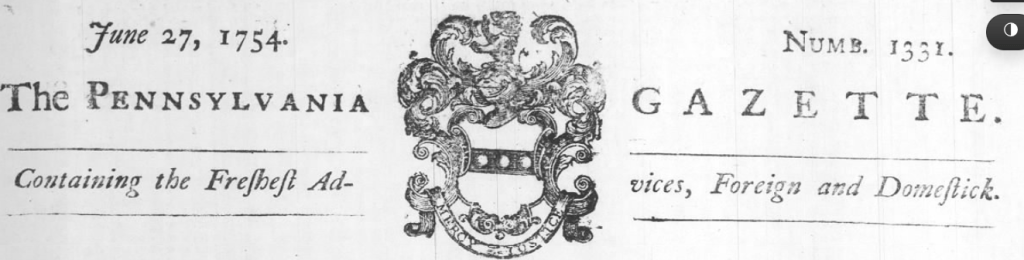
Anyone reading the Pennsylvania Gazette in the 1750s could not have missed the numerous adverts placed by subscribers offering a reward and ‘reasonable charges’ for the return of runaway servants.
The Oxford Research Encyclopedia claims that between the 16th and 18th Centuries, approximately 320,000 indentured servants sailed from the British Isles and other parts of northern Europe across the Atlantic to the British colonies in North America. These servants, comprising three-quarters males, one-quarter females, and one-tenth children, made up approximately 80 per cent of white immigrants.
Unsurprisingly, most indentured servants were young, between 18 and 25 years old, and impoverished. They generally agreed to be indentured for four to seven years; most were in service between New Jersey and Virginia, while indentured servitude was less common in the other colonies. Not all who entered indentured servitude did so willingly; there were several cases of people being kidnapped.
One of the most notorious cases was that of Peter Williamson, who was taken from the quay at Aberdeen in January 1743. Williamson was sold in Philadelphia to Hugh Wilson for £16. Wilson was, like Williamson, a Scot who had himself been kidnapped when at a similar age. Wilson, who Williamson said had treated him kindly, died shortly before Williamson’s indenture ended. Wilson left his servant £120 in his will, along with his best horse, saddle, and clothes.
Although most of those who entered into indentured servitude did so willingly, they were largely unaware of the control over their lives that their masters and mistresses would wield. Although treated better than African chattel slaves, who were bound to their ‘owners’ for life, they would have less freedom in their day-to-day lives than if they remained in Europe.
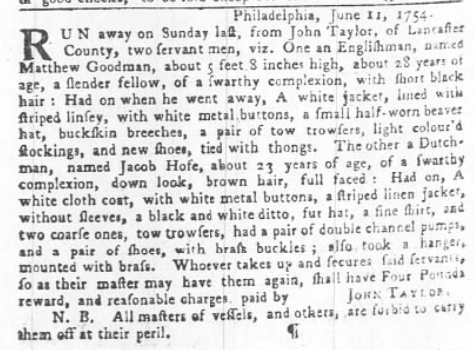
On Thursday, 27 June 1754, two correspondents placed items in the Pennsylvania Gazette requesting assistance in the apprehension of servants indentured to them. John Taylor of Lancaster County, Pennsylvania, offered ‘Four Pounds , and reasonable charges,’ for the return of ‘two servant men’. Taylor included detailed descriptions of both men, one of whom was an Englishman named Matthew Goodman. He was: ‘about 5 feet 8 inches high, about 28 years of age, a slender fellow of swarthy complexion, with short black hair.’ Taylor noted that when he ‘went away’ he was dressed in ‘A white jacket, lined with striped linsey, with white metal buttons, a small half-worn beaver hat, buckskin breeches, a pair of tow trowsers, light colour’d stockings, and new shoes, tied with thongs.’
The second absentee servant was a Dutchman named Jacob Hose. According to John Taylor’s equally as comprehensive description, Hose was: ‘about 23 years of age, of a swarthy complexion, down look, brown hair, full face.’ Taylor gave a precise inventory of what Hose had been wearing: ‘A white cloth coat, with white metal buttons, a striped linen jacket, without sleeves, a black and white ditto, fur hat, a fine shirt, and two coarse ones’. As with Goodman, Hose had on a pair of ‘tow trowsers.’ The Dutchman also had in his possession ‘a pair of double channel pumps, and a pair of shoes, with brass buckles.’ Taylor added that Hose also took ‘a hanger mounted with brass’, presumably belonging to Taylor.
On the last line of the item, John Taylor informed, ‘All masters of vessels, and others, are forbid to carry them off at their peril.’
Rewards for absconded servants and slaves varied greatly, whereas John Taylor offered £4 for the return of Goodman and Hose, in the 4 July edition of the same newspaper, John Montgomery of Mill-Creek Hundred, in Newcastle County, was offering ‘Thirty Shillings, and reasonable charges’ for the return of ‘a Negroe woman, aged about 28 years of age, nam’d Kate, smooth faced, a good black, 5 feet 6 inches high. Had on…a calicoe gown, blue quilted petticoat, and carried off with her several other clothes.’ Kate had been absent from Mill-Creek for more than two weeks when Montgomery appealed for her return.
In the same issue, John Potter of Chester county advertised the absence of ‘a Dutch servant man, named Philip Sinloup…a thick set fellow, with fair hair…and very hairy on the breast, about 48 years of age, and professes to be a mason and plasterer by trade.’ It appears that Sinloup, who had been gone for a week when the item appeared in the Gazette, should have been easily recognisable, he was dressed in ‘a brown cloth jacket, with one sleeve torn off of it, and a shirt with a piece likewise torn out of it…an old hat, with several small shot holes through it.’ Potter was offering ‘Forty Shillings’ for Sinloup’s return.
In the same edition of the Gazette, Stephen Onion, the owner of an ironworks on the evocatively named ‘Gun-powder’ river in Maryland, was still on the lookout for two servants who had absented themselves on 2 June. They were both Dutchmen, one with the presumably anglicised name of Nicholas Gardiner, ‘about 35 years of age, of low stature, thin visage, high nose…has a mark on one of his arms with gun-powder.’
Gardiner’s companion was Conrad Hents ‘a well-set middle siz’d fellow, round visag’d…but pretty full of pimples.’ Onion was offering a reward of £6 for his two servants.
Originally from Hertfordshire, Thomas Freeman had gone missing from Reading Furnace in Chester County. He had initially been indentured to Peter Matson, of Upper Merion, Philadelphia County. He had run away from Matson on several occasions. Once, when he returned, he tried to cut his own throat, leaving a scar near his windpipe. There was no description of what Freeman was wearing when he left, as most of his clothes remained behind when he fled. Anyone who apprehended Freeman, who had been spotted at the ferry on the Schuylkill River, could return him to Reading Furnace or any gaol. Freeman, ‘much addicted to liquor, and then very talkative’, would garner his captor a reward of £3.
James Woods, an Irish weaver, ran away from his master in Chester County. He was ‘6 feet 2 inches high, but slender.’ Woods’ stated reward was thirty shillings, the same amount that was offered for the capture of Kate,’the Negroe woman’.
Conrad Hendrick Earns, a native of Hanover, had left his master John Leadlie, of Philadelphia County. Earns was unable to speak English, and did not appear to have been very well regarded by Leadlie, who said: ‘He professes to be a doctor, and had cupping boxes of glass, and other instruments for cupping and bleeding; and perhaps may pass for a taylor, knowing something of that business, but little of either.’ Leadlie was willing to pay 40 shillings for Earns’ return.

William Brown had much in common with James Woods; he was Irish, a weaver, and had also been working in Chester County. Like Woods, his reward was scant at just forty shillings; if he were recaptured in a different province, the reward would be increased to £3. John Jack, Brown’s master, reported, ‘It is supposed that he has his Indenture with him, and some other papers which can’t be found.’ Jack added that Brown ‘may probably, at this time, go a mowing, he professing to be a good mower.’
Although it is only a small sample, the Irish servants like Brown, ‘a great blasphemer,’ and Woods were worth appreciably less to anyone who captured them than the English or Dutch servants. The smallest reward I discovered was for Thomas Miller, who had absconded from his master in Salisbury, Lancaster County. Miller, whose nationality is unknown, was worth twenty shillings to George Boyd, his master.
© Mark Young 2025
Sources
https://www.newspapers.com/article/the-pennsylvania-gazette-run-away/172176164/
https://www.newspapers.com/article/the-pennsylvania-gazette-more-runaways/172202769/
https://www.newspapers.com/article/the-pennsylvania-gazette-a-great-blasphe/172514482/
https://en.wikipedia.org/wiki/Indentured_servitude_in_British_America

 Hellish Fiends, and Brutish Men
Leave a comment