
Although he was inextricably linked with the Orkney Isles, John Gow was born on the Scottish mainland at Wick, a stone’s throw from John O’Groats, around 1698. Like numerous others of his ilk, Gow ended his days at Execution Dock on the banks of the River Thames at Wapping on 11 June 1725.
Gow spent his early years across the Pentland Firth in Stromness, where he went to school and subsequently learned the intricacies of sailing. During the 18th century, Stromness Harbour was much busier than it is today. The Hudson’s Bay Company (HBC) ships used to stop at the harbour before making their way west across the wild North Atlantic. A large part of the HBC’s workforce was Orcadian.
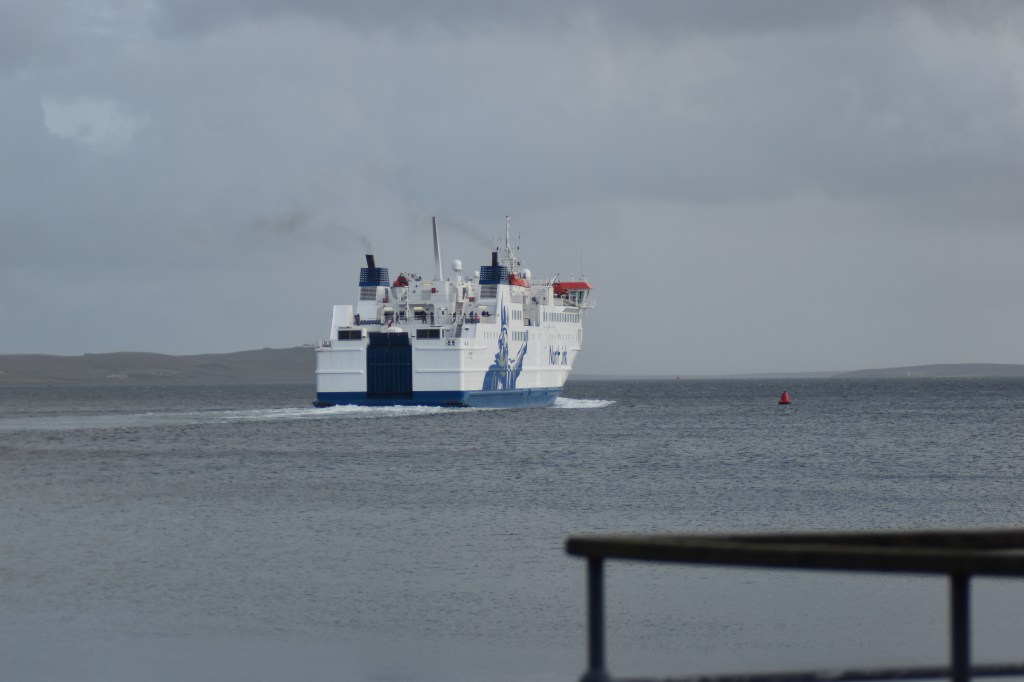
The HBC vessels were not the only ships docking at Stromness; whalers would resupply there before heading northwest into the whale-rich waters around Iceland, Greenland and the Arctic. Stromness was also known as Hamnavoe; today, the NorthLink ferry that services the route from Scrabster to Stromness is the MV Hamnavoe.
The Northlink Ferry MV Hamnavoe leaving Stromness Harbour, bound for Scrabster, 4 October 2023.
In the early summer of 1724, John Gow joined the crew of a vessel embarking on a round trip from London to Lisbon. Somewhere en route, it isn’t specified in the sources whether it was the outward journey or the return leg; Gow tried to seize control of the unnamed ship. Unable to recruit enough followers to his side, his scheme failed.
On returning to London, word soon spread of Gow’s mutinous designs. Fearing repercussions, Gow fled to Amsterdam, where he joined the Caroline, acting as second mate on the vessel bound for Santa Cruz on the Canary Island of La Palma.
The Caroline remained at anchor in the harbour at Santa Cruz for several months; on 3 November 1724, she departed for the Italian port of Genoa, her hold laden with beeswax, leather, and woollens. The Newgate Calendar reported that before the ship left port, several merchants whose goods the Caroline was transporting boarded the vessel to give Captain Freneau, the officer in charge, his final instructions.
Captain Freneau met with the merchants under an awning on the Caroline’s quarter-deck. While Freneau conversed with the merchants, he was dismayed when some men came forward to complain about their ill-treatment, particularly concerning the short food allowance.
Freneau believed the complaint had been made to lessen him in the eyes of the merchants. Despite being angered by the unfounded complaint, he managed to keep his cool. Freneau pointed out to the disgruntled crewmen that a steward aboard took care of the provisions ‘and that all reasonable complaints should be redressed.’ The crewmen withdrew, their concerns having been assuaged by Freneau’s response.
As soon as the merchants had left the ship, Captain Freneau gave the order to weigh anchor, and the Caroline left port heading for Genoa. The vessel had not long left Santa Cruz when a sailor named Paterson, one of the malcontents, was observed to be ‘very dilatory in executing his orders,’ Freneau demanded to know why Paterson was unwilling to unfurl the sails. Paterson did not answer his captain but was heard to mutter quietly, ‘As we eat, so shall we work.’ If Freneau heard Paterson’s comment, he chose to ignore it.
The Caroline hadnot long slipped out of Santa Cruz harbour when Freneau became aware that the grievances raised when the merchants came aboard the ship had not been settled, and an uneasy air hung over the ship.
Captain Freneau consulted with the first mate, and they decided to keep pistols in the cabin to defend themselves if the crew became mutinous. Unfortunately for them, Freneau and the mate discussed the matter on the quarter deck and were overheard by two of the disillusioned crew.
Freneau instructed the first mate to order John Gow, the second mate and gunner, to clean the guns. This order convinced the nefarious Gow that a conspiracy to take over Caroline was suspected.
Gow, who had harboured intentions of taking over Caroline, held a conclave with his confederates. The conference’s outcome was that the conspirators decided to act to take control of Caroline that night.
Each evening at eight o’clock, those of the ship’s company not busy with their duties gathered in the great cabin for prayers. All but two of the conspirators were off duty, whether by planning or luck, and they gathered in the cabin, some perhaps praying that the All Mighty would give them strength to take the path they had seemingly all chosen.
Gow and his allies had planned to stage their coup at this point. After they exited the cabin, the men retired to their hammocks, ostensibly to rest until it was their turn to return to their duties. Gow had chosen a watchword that, when spoken, would rouse the men from their hammocks and set them on the path from which there was no return.
Sometime between around ten o’clock, the words ‘Who fires first?’ Were spoken. This was the codeword for the men to put their plan into action. Hearing this, some of the mutineers rolled out of their hammocks and headed for the cabins of the first mate, surgeon and supercargo. Gaining entrance to the officers’ quarters, they slit the men’s throats while they slept.
The commotion roused Captain Freneau, and he asked the Boatswain what was occurring. The Boatswain was uncertain but thought some men had fallen or been thrown over the ship’s side.
Freneau marched to the side of the ship to check the veracity of the Boatswain’s claim when he was grabbed by two of the mutineers. Freneau shrugged his assailants off and turned to face them. One of the men brandished a knife and slashed Freneau’s throat, and the second attacker plunged his blade into the captain’s back with so much force that he could not remove the weapon. John Gow, who had engaged in the murder of the sailors who had remained loyal below decks, emerged on the quarter deck and fired a pair of pistol balls into the captain.
Freneau’s corpse, along with those of the other slain men, was pitched over the side of the Caroline into the dark, roiling waters. In the aftermath of the slaughter of Freneau and his loyalists, Gow was unanimously elected captain unopposed.
Not all of the remaining crew were allied with Gow, and these men were doubtless fearful that they should share the same fate as their murdered brethren; they were put to work manning the ship while John Gow and his murderous acolytes held another meeting, secrecy was not required this time. The decision was made that piracy was their future.
That night, looted alcohol flowed feely on the quarter-deck; the officers’ cabins were ransacked, anything of value purloined. By the following morning, four of the crew who had not been involved in Gow’s conspiracy joined his company. Of the 24-man crew that had left Santa Cruz, four had been killed, their bodies were thrown overboard, eight men stood aloof from the mutineers, and the other twelve, including John Gow, had embraced the life of a pirate.
The following day, as the newly minted pirates suffered from pounding heads from a surfeit of alcohol and perhaps one or two among their members regretted their actions of the previous night, John Gow addressed those who had elected not to join the pirate crew. Gow told the eight crew members who had stood apart from the mutineers that the ship was about to embark on a cruising voyage, adding that they would be treated well if they agreed to join the rest of the crew.
Gow blamed the assassination of Freneau and the other officers on the captain’s inhumanity. When the eight made no reply to Gow’s entreaties, he understood that they were willing to do their duties as they had carried them out previous to the killings.
In the days after Gow and his men had usurped control of the Caroline, the captain’s cohort grew wary of the recalcitrant crew members who had shown no interest in joining with those who had taken part in the murders. Gow’s lieutenant, a man of a vicious disposition named Williams, stalked the quarter deck and took pleasure in beating the innocent crew members. Some of the mutineers had grown to loathe and distrust the eight, fearing they would betray them to the authorities if the opportunity arose.
The pirates seized a ship named the George and rechristened it the Revenge, a much more suitable name for a vessel crewed by men such as Gow’s cohort. Soon after they claimed an English ship carrying fish from Newfoundland to Cadiz. The cargo was useless to the pirates; they scuttled the craft and took the captain and his four crew aboard the Revenge.
A Scottish ship carrying pickled herrings was captured; thus far, the pirates had not had much luck gaining the riches they had envisioned. A French vessel was chased for several days before she eluded her pursuers in a fog bank.
In dire need of water, the Revenge headed for Madeira, which they reached in two days. Gow decided against entering the harbour and instead plied the waters looking for a Spanish or Portuguese vessel to plunder. Once more, they were thwarted in their desires; thus far, things were not going as they had hoped. Some pirates were likely starting to question their decision to dispose of Captain Freneau and elect John Gow, who was proving to be singularly hapless as their chief.
Returning to Madeira, the Revenge anchored outside the harbour. They attempted to board one of the ships in the harbour but were denied. Weighing anchor once more, the pirates headed to the settlement of Port Santa.
Gow sent a party of his men ashore, carrying with them presents of salmon and herring taken from two of the merchant ships they had captured earlier, as presents for the Portuguese governor. The Portuguese dignitaries greeted the pirates cordially, and the governor and some of his allies returned to the Revenge at the invitation of the pirates.
The pirates and the Portuguese had got on famously. The governor and his retinue prepared to leave the regale and return to the shore when their previously convivial hosts turned on them. The Portuguese lives were threatened unless they provided everything that the pirates desired.
Gow’s bluster and belligerence worked wonders with the cowed officials. The governor repeatedly sent a boat to the shore until, at last, the men of the Revenge were satisfied, and the Portuguese were allowed to return to the dock and the sea rovers set sail for the Spanish coast.
The Revenge took two prizes off of Spain, an English Guineaman, laden with slaves. They took no cargo from the slaver, but instead dispatched some of the crew from one of the ships they had captured to it.
They also captured a French craft carrying a cargo of wine, oil, and fruit in its hold. Gow presented the ship to the Scottish captain, whose ship had been sunk by the pirates some weeks earlier.
The day before, the crew had spied a second French ship. When it was observed that the vessel carried thirty-two guns, Gow, with the agreement of the majority of his crew, decided that discretion was the better part of valour and declined to engage with the craft.
Williams, the lieutenant who had taken such delight in whipping the Freneau loyalists among the crew, upbraided Gow for his perceived cowardice, stating that he was not fit for command. Williams demanded that the Revenge attempt to take on the better-armed French ship, but Gow calmly declined to adhere to Williams’ request. At this point, the bellicose lieutenant pulled his pistol out and fired it at Gow.
William was thwarted in his attempt to assassinate Gow as his pistol flashed in the pan and failed to fire. Winter and Paterson, two pirates stationed on deck near the officers, fired their weapons at Williams; one pistol struck the lieutenant in the arm, and the second wounded him in the stomach.
Williams dropped his pistol and fell to the deck. Members of the crew grabbed hold of the lieutenant, believing him to be dead, and intending to throw him overboard. Although grievously wounded, Williams was not dead; he shrugged the men off and leapt into the hold with the stated intention of setting fire to the powder-room, blowing the ship and the crew up.
Before Williams could make good on his promise, he was grabbed by some of his erstwhile comrades, his hands were chained together, and he was placed among the prisoners taken from the French ship which carried the Wine and fruit.
Williams remained amongst the matelots for two days until the Revenge came upon a Bristol vessel carrying salt fish from Newfoundland to Oporto. The French prisoners were transferred to the Bristol merchantman when Gow or one of his men requested that Williams be also taken and handed over to the first British man-of-war they encountered.
Discovering his fate, Williams begged that his former friends take him back; when that request was denied out of hand, he asked that he be thrown overboard. Again, Williams’ wish was turned down, the men of the Revenge wished their former lieutenant ‘a good voyage to the gallows’ when he was taken aboard the Bristol ship. Williams was handed over to the captain of a British man-of-war when the Bristol vessel made landfall in Lisbon.
Once the Revenge parted from the craft carrying Williams and the French prisoners, the crew was concerned that naval ships would pursue them once news of their piracy reached official ears.
The crew held a council, debating in which direction they should flee. Some men voted for North America, others for the coast of Africa, and yet more for the waters of the Caribbean. Gow demurred when the crew debated the destinations. Instead, he suggested the Orkney Islands, where they could sell their goods, retire and live on the profit they accrued.
Gow felt that if any ships did commence a search for the Revenge, they would not scour the seas around the Northern Isles; instead, they would look in the places more often frequented by pirates, like the West Indies or off the east coast of North America.
If Gow’s aim by heading north was to evade the eye of the authorities, his following statement contradicted that. He told his men that if they followed his instructions, they could rob houses along the islands’ coasts, so much for lying low.
Persuaded by their captain, the crew steered the Revenge northwards. Gow had instructed his men that their cover story was that they were a ship bound for Cadiz from Stockholm, and were forced into the Orkneys by contrary winds; they docked to repair their ship and would pay merchants for any goods they needed.
A smuggler’s vessel from the Isle of Man, laden with French brandy and wine, lay at anchor in the bay. The ship had travelled the northern route around the coast of Britain to escape attention from the Revenue cutters. Gow and his crew exchanged merchandise with the smugglers and did likewise with a Swedish craft a few days later.
While the Revenge lay at Anchor, some of the crew who had remained with Gow and his cohort reluctantly, began constructing plans to leave the pirates behind. One evening, the Revenge’s boat was rowed to shore; one of the crew was a man who had not taken part in any of the robberies. He slipped away from his companions and defied their attempts to find him, leaving his place of concealment at a farmhouse, he hired someone to guide him to Kirkwall. Kirkwall was, and remains, the largest town in the Orkney Islands.
The crewman met with a magistrate. He unburdened himself to the official, going into great detail concerning Gow’s activities, including the murder of the four officers and the several acts of piracy in the weeks that followed. He was adamant that he had been forced into the crew against his will and had stood aloof when the crimes were carried out. Persuaded by the sailor’s story, the magistrate passed on the news of the presence of Gow and his crew in the islands to the local constables.
At around the same time, the crewman had absconded from the company, ten of his like-minded companions had stolen the Revenge’s longboat. Rather than make for Kirkwall, the men rowed their craft down the east coast of the Scottish Mainland until they reached the nation’s capital. At Edinburgh, they were arrested on suspicion of being pirates.
Unperturbed by the desertion of eleven of his crew, however dedicated to the pirate life they were, Gow decided not to put to sea; instead, the Revenge remained in the Northern Isles. Gow sent off his boatswain and a boatload of pirates, intending to pillage the house that belonged to Mr. Honeyman, the county’s high sheriff.
Fortunately for Honeyman, he wasn’t at home when the ruffians from the Revenge arrived to ravage his home; less lucky were the high sheriff’s wife, daughter and servants. When the pirates rapped on the door, the servants opened it, and nine of the pirates rushed in, leaving the remaining freebooter to guard the entrance.
Despite the fear felt by Mrs. Honeyman and her daughter, not to mention the servants, the pirates are reported not to have mistreated them. They ransacked the house, plundering it of linen, plate and other treasures. When they left to return to their vessel, they were led by a household member playing an air on a set of bagpipes.
After leaving the high sheriff’s property, Gow and his crew sailed for Calf Sound. James Fea, Gow’s erstwhile schoolmate, resided at Carrick House. Gow believed that news of the raid on the Honeyman property would not have reached Fea’s ear in such a short amount of time.
As the Revenge entered Calf Sound, she sailed too close to the Calf of Eday and was nearly wrecked on the rocks of the small island. Gow sent one of his team in a boat with a letter to James Fea requesting his help getting the ship away from the rocky shore.
Gow’s emissary quickly found Fea. Fea showed little interest in helping Gow’s men with the Revenge, and shrugged the messenger off with an ambivalent answer. When night fell, Fea instructed some of his servants to remove and hide the sails and rigging from his boat and sink the vessel, lest the pirates should discover it.
When the servants were carrying out Fea’s directive, a boatload of pirates from the Revenge, armed as if expecting a skirmish, rowed towards shore. Fea, having watched the men spill from the boat and head towards his house. He halted the pirates before they could gain entrance to his home.
Fea begged the men not to cross the threshold, his wife having seen the men with their pistols and muskets primed and was deathly afraid. The boatswain assured Fea that the pirates had no interest in causing Mrs. Fea any distress, but if the loan of Fea’s boat were denied them, then trouble would ensue.
Fea managed to dampen the ire of the boatswain and his comrades; he explained that helping the pirates would bring trouble on his head. He offered to host the pirates in a local tavern, an offer the sea robbers were quick to acquiesce to. While the men were supping ale in the hostelry, Fea repeated his order to his employees to sink his boat, and when the task had been completed, to report back to him.
After his men had finished their assignment, they informed Fea. Out of earshot of the pirates, Fea ordered six men to arm themselves and hide behind a hedge that ran beside the road from Fea’s house to the inn. If the boatswain accompanied Fea, his employees would grab the sailor. If all the pirates followed him, Fea would try to leave enough room for his men to discharge their muskets at the pirates without shooting Fea.
Returning to the inn, Fea invited the men of The Revenge to his home if they swore to behave acceptably. The rough-hewn sailors agreed to Fea’s conditions, believing therein lay their chance of getting his boat.
James Fea then said he would prefer to proceed with just the boatswain, and the rest of the crew could join them later. The pirates again acquiesced to Fea’s suggestion.
Armed with a brace of pistols, the boatswain followed Fea from the inn towards his house. The two men walking in step reached the hedge where the six armed men lay hidden. Fea grabbed the boatswain by his collar, and the rest of the men quickly overpowered him. The boatswain tried to call out to his comrades, but Fea stuffed a handkerchief in his mouth to silence him. He was quickly bound and gagged; Fea left one man to guard him and returned to the inn with the remainder of his men.
The inn had two entrances. Fea’s men split into two groups and burst into the building simultaneously, quickly overwhelming the pirates before they had time to retrieve their weapons. The prisoners were then sent to a village a short distance away and confined separately.
Fea next sent messengers around the island to inform them of the pirates’ capture and request that the islanders haul their boats onto the beach so that those men remaining aboard The Revenge could not swim out and steal any of the boats. He also asked that no one row within range of The Revenge’s guns.
The next day, the wind changed direction to a north-westerly, raising the pirates’ hopes that they could leave Calf Sound behind and reach the open sea.Instead of making their escape, however, the crewman whose task was to cut the ship’s cable botched his job, and The Revenge was driven onto the island’s shore.
Now up a creek, and literally without a paddle, John Gow waved a white flag from the deck of his ship, signalling to James Fea that he was willing to parley with him. Fea sent four armed men in a boat across to The Revenge with a message informing Gow that Fea had detained the boatswain and his comrades, ‘on account of their insolent behaviour’. Fea’s missive added that the country was aware of Gow’s presence, and his only chance of preserving his life was to surrender and submit testimony against his crewmates.
Gow rebutted Fea’s suggestion, sending a letter, stating that he would ‘give goods to the value of a thousand pounds to be assisted in his escape; but if this should be refused, he would set fire to the ship, rather than become a prisoner.’
On receiving Gow’s response, Fea decided to meet with Gow on The Revenge’s main deck. Fearing duplicity on the part of the pirates, before boarding the boat to take him to the rendezvous, Fea positioned a man atop his house, where he had a clear view of the ship. If any of the pirates should leave The Revenge and attempt to swim to shore, the man was instructed to wave the flag once if one pirate attempted the feat; if four of the freebooters endeavoured to reach land, the man should wave the flag continuously until Fea and his men were out of danger.
Coming within hailing distance of the ship, Fea raised a speaking trumpet to his mouth and asked Gow to go ashore and meet with him. Gow agreed to Fea’s request. After receiving the pirate chief’s response, James Fea spied a pirate carrying a white flag slip into the water from the Revenge, and made for the shore.
Observing the swimming pirate, the man on watch in Fea’s house waved the flag; a moment later, the man was seen to wave the flag more hectically. The men in the boat with Fea noticed five more pirates swimming for shore. The boat moved a safe distance from the sea rovers’ vessel. Seeing they were discovered, the pirates returned to the Revenge.
The pirate with the white flag had made landfall. He informed Fea that John Gow had sent him a bottle of brandy. Fea responded laconically that he hoped to see Gow hanged and had a mind to shoot the messenger. The pirate made a hasty return to his fellows. Whether he left the brandy in Fea’s possession is unrecorded.
Gow then addressed a letter to Mrs. Fea, asking her for help talking with her husband. Mrs. Fea was wholly uninterested in helping Gow and rebuffed the pirate captain. Despite not receiving a positive response, Gow decided to head for land and parley with Fea.
James Fea watched Gow’s progress from the sanctuary of his house; he sent a boatload of his men to intercept Gow and either capture or kill him. Gow and Fea’s party held a brief discussion. Gow persuaded one of the men to act as a hostage and go aboard the Revenge.
Watching from afar, Fea was incredulous at what had transpired. Storming across to meet with Gow, he informed the pirate that he could now consider himself a prisoner while remonstrating with his men for allowing one of their number to act as a hostage aboard the pirates’ ship.
Gow maintained that he couldn’t be a prisoner while a man acted as a hostage in his stead. Fea blustered in response that he had not ordered the man to go aboard the Revenge, and any fate that befell him was his concern. He added that it would behove Gow to signal his comrades aboard their craft to release the man.
Gow declined to acquiesce to Fea’s suggestion. Using the flag that Gow had brought ashore with him, Fea signalled the vessel, and shortly afterwards, the hostage was brought forth, accompanied by two pirates. Fea’s men promptly apprehended the pirates.
John Gow was then disarmed, and he begged Fea to have him shot with his sword still in his possession. Fea ignored Gow’s plea and bade him lure the men remaining aboard the Revenge onto shore.
After all the pirates disembarked from the Revenge, Fea notified the authorities in Edinburgh of the capture of Gow and his comrades. While awaiting the arrival of a force to convey the men of the Revenge, which its crew had renamed the George, to Edinburgh, Fea carried out a thorough inventory of the ship.
The search of the Revenge turned up six copies of a pirate code compiled by John Gow, which was agreed upon by all the crew after the vessel had run aground. The articles read:
I. That every man shall obey his commander in all respects, as if the ship was his own, and as if he received monthly wages.
II. That no man shall give, or dispose of, the ship’s provisions; but every one shall have an equal share.
III. That no man shall open, or declare to any person or persons, who they are, or what designs they are upon; and any persons so offending shall be punished with immediate death.
IV. That no man shall go on shore till the ship is off the ground, and in readiness to put to sea.
V. That every man shall keep his watch night and day; and at the hour of eight in the evening every one shall retire from gaming and drinking, in order to attend his respective station.
VI. Every person who shall offend against any of these articles shall be punished with death, or in such other manner as the ship’s company shall think proper.
The pirate code is one of only three that survived the 18th century. Most of the articles were burned by the men who compiled them, fearing they would be used as evidence in the event of their capture.
The pirates were transported to Edinburgh and boarded the frigate Greyhound for London. On arrival in the capital, they were escorted by a detachment of guards from the Tower of London and taken to Marshalsea prison, where they were reunited with their erstwhile comrade, Lieutenant Williams, who had arrived from Lisbon aboard the British man-of-war.
In no way disabused as to his ultimate fate, Williams took delight in discovering that his former crewmates had ended up in the same predicament. A short while after arriving at the Marshalsea, the men were examined before a judge of the Admiralty Court at Doctors’ Commons. Five of the sailors were judged to be less guilty of the crimes they were accused of than their fellows, and they later gave evidence against Gow, Williams and their cohorts.
Gow and the others were moved to Newgate prison. They were tried at the Old Bailey. Gow, who had been in a sombre mood ever since he was consigned to prison, Williams and six others were found guilty and received the death sentence. The rest of the company was acquitted.
While at Newgate awaiting his meeting with the executioner, Gow was visited by Presbyterian ministers, ‘who laboured to convince him of the atrociousness of his crime; but he seemed deaf to all their admonitions and exhortations.’
Lieutenant Williams, on the other hand, seemed to revel in his notoriety. He informed visitors to his Newgate cell that he told Gow to tie the prisoners they had captured back to back and throw them in the sea. After all, dead men tell no tales.
John Gow, Williams and their six comrades were hanged at Execution Dock, on the banks of the Thames, on 11 June 1725. On the first attempt to hang John Gow, the rope broke. The second time Gow was pitched towards eternity, some of his friends in the crowd pulled on his legs, hastening his death.
After the men were cut down, they were hanged in chains near where they died—a salutory example for any man contemplating a similar way of life.
© Mark Young 2025
Sources
https://goldenageofpiracy.org/pirates/john-gow

 Hellish Fiends, and Brutish Men
Leave a comment