
When the First World War broke out, Carl Lynn enlisted in the Canadian army at North Battleford, Saskatchewan. He served as a sniper for four years in the trenches of the Western Front. After returning from Europe, Lynn worked as a fur trapper in northern Saskatchewan. It was ‘in the hinterland of Saskatchewan’where he lost his life after a ‘death struggle with hunger-crazed timber wolves’.
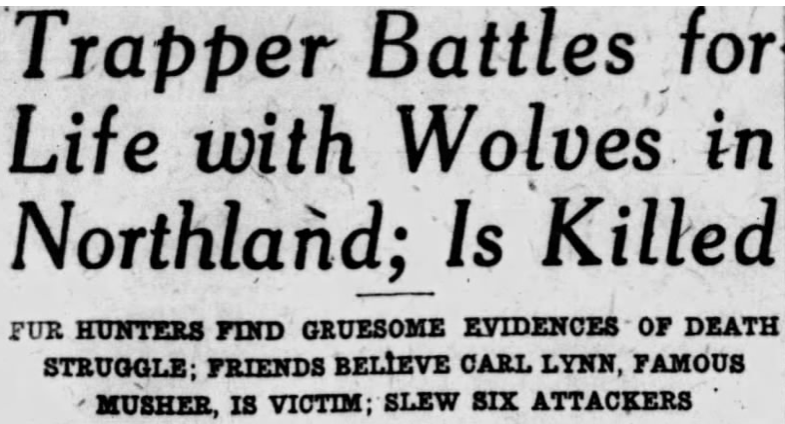
Saskatoon Daily Star, Friday 16 March 1923
Carl Lynn had worked for the Hudson’s Bay Company (HBC) and their less well-known competitor, Revillon Frères. The latter company was half a century younger than its rivals, but by 1909, it had 48 stores between Lake Nipigon and James Bay, while the HBC had four more stores.
In 1926, the HBC acquired 54 per cent of Revillon’s shares; ten years later, it purchased the remainder of the shares, making Revillon Frères a wholly-owned HBC subsidiary. Two years later, HBC renamed the subsidiary Rupert’s Land Trading Company.
Carl Lynn was scheduled to be at the HBC post at Île-à-la-Crosse, a village in northwestern Saskatchewan. The village is the second oldest settlement in the province, and trading posts were established there as early as 1778. The village is situated 457 miles north of the provincial capital, Regina.
Lynn had a reputation among his associates for never breaking an engagement. On 16 March 1923, the Windsor Star and The Saskatoon Daily Star broke the news of Carl Lynn’s apparent death to the broader public.
At the north end of Cree Lake, a body of water that lies 200 miles north of Île-à-la-Crosse, two ‘fur hunters’ discovered ‘Mute and ghastly evidences of a trapper’s death struggle’.
The two men could find no sign of Carl Lynn; they recovered his rifle and ‘shreds of his coat and trousers.’ Near where the weapon and remnants of the ‘famous musher’s’ clothes were scattered, ‘the carcasses of six big wolves.’ The hunters noted that Lynn’s trapline had not been worked in at least a week. Unable to locate Lynn, the men returned to Île-à-la-Crosse.
The next mention of Carl Lynn in the newspapers was on 27 March, when the Saskatoon Daily Star reported that Inspector R.R. Tait of the Saskatchewan Provincial Police received a telegram from the Île-à-la-Crosse detachment, stating simply that: ‘Carl Lynn arrived here safely last week.’
Joseph Nolin, the polyglot Métis Liberal MLA for the Île-à-la-Crosse riding, had been unequivocal in his belief that Lynn was the man who had lost his life on Cree Lake, however, on 13 April, he was quoted by the Daily Star as saying, ‘Carl Lynn, the trapper, may be alive, but timber wolves certainly killed one white man.’
That was the last time I could find Carl Lynn mentioned in the newspapers. If he had survived and some anonymous man had fallen prey to the wolves, there would have been some follow-up by at least one of the newspapers. I could not find Carl Lynn in the 1931 census, so I am left to conclude that Carl Lynn did indeed lose his life at the north end of Cree Lake, a lake that is today only reachable by float plane, sometime in late February 1923.
© Mark Young 2024
Sources
Websites
https://en.wikipedia.org/wiki/Île-à-la-Crosse
https://en.wikipedia.org/wiki/Cree_Lake
Newspapers
The Windsor Star (Ontario)
The Leader-Post (Regina)
The Star-Phoenix (Saskatoon)
The Saskatoon Daily Star

 Hellish Fiends, and Brutish Men
Leave a comment